Table of Contents
- Introduction
- Why Most Pitches Get Ignored
- The Five-Part Pitch Structure
- Using Real Engagement Data
- Subject Line Best Practices
- Personalization That Actually Works
- Follow-Ups Without Being Annoying
- Avoiding the Spam Filter
- Attaching Your Media Kit
- Pricing With the CPM Formula
- Frequently Asked Questions
- Final Takeaway
Most sponsorship pitches are ignored because they are generic. The five-part structure, real numbers, and a subject line built to be opened turn your email into a reply.
Brands are not ignoring you because your channel is small. They are ignoring you because your email did not give them a reason to stop. A sponsorship pitch is a thirty-second decision: the brand manager skims, decides whether you are a fit, and either replies or moves on. Winning that thirty seconds is a craft with a repeatable structure — a hook that earns attention, a value statement that fits their campaign, real numbers instead of adjectives, a defensible rate, and a clear ask. Every part is learnable, and none of it depends on your subscriber count. This guide breaks down the five-part structure, the subject lines, the follow-ups, and the CPM pricing that gets replies.
Introduction
The brands that sponsor YouTube creators receive dozens of pitches a week. The ones that get replies share the same DNA: they are short, specific, personal, and they lead with the numbers a brand manager already knows how to read. This guide covers why most pitches get ignored, the five-part structure that fixes it, how to present your real engagement data, subject line best practices, personalization that is more than a name-swap, follow-up timing, spam-filter avoidance, and the CPM formula that prices your rate so it feels professional instead of invented.
Why Most Pitches Get Ignored
The three silent killers of sponsorship emails are generic mass-mailing, vague claims, and no clear ask. A pitch that opens 'Dear Creator Manager' and talks about 'growing your brand' reads as bulk spam and dies in the first sentence. A pitch that says your audience is 'highly engaged' without a number proves nothing. And a pitch that ends without a specific ask — a rate, a deliverable, a next step — leaves the brand manager with homework, and homework gets ignored. There is also the volume problem: if you send the same email to forty unrelated brands, you are spam. If you send five tailored emails to brands your audience actually fits, you are a professional. The fix for all three is structure and specificity, which is exactly what the rest of this guide provides.
The Five-Part Pitch Structure
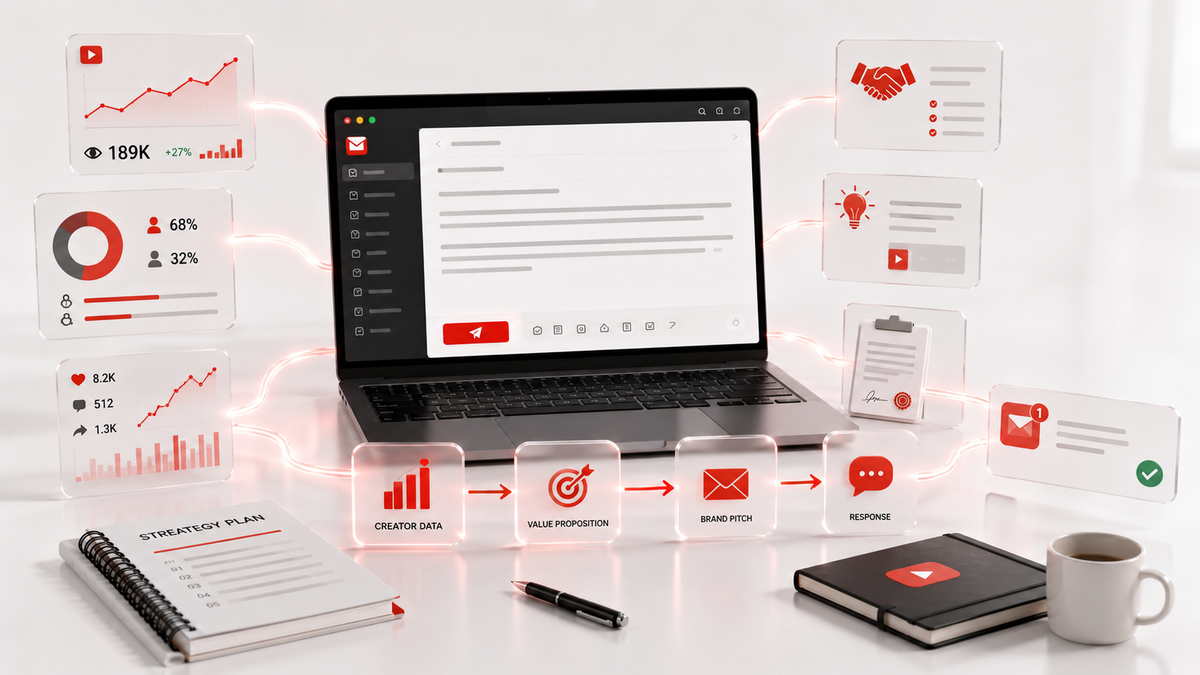
Keep the email under 120 words and build it in five moves:
- Hook: one line that names the brand and why this email is different. 'I am a tech reviewer whose last three videos each hit 20,000 views — here is the one your product belongs in.'
- Value: one line connecting your audience to their campaign. Name the fit, not your love of the brand. '70% of my viewers are US-based, and the comment sections on my product videos run heavy on the exact 'is it worth it' questions your ads are built to answer.'
- Stats: two or three hard numbers from the last 90 days — average views, engagement rate, subscriber count. Numbers, not adjectives.
- Rate: one line with your rate card or a starting range, plus what it includes. 'A dedicated video runs $450 including one revision and a 30-day sponsor placement; a Shorts integration is $180.'
- Ask: one clear next step. 'If this fits your spring campaign, reply and I will send my media kit and available dates.'
The whole thing fits on a phone screen and takes a brand manager twenty seconds to evaluate. That is the point. Here is a complete example so the structure is concrete. Subject: Finance reviewer for [Brand] — 25k avg views Hi [Name], I run a personal finance channel whose last three videos each passed 25,000 views, and your budgeting app is exactly the tool my audience asks about in comments. 70% of my viewers are US-based, engagement runs at roughly 6% of views, and my product videos convert well because I test everything for a month first. A dedicated video runs $700 including one revision and a 30-day integration; a Shorts spot is $250. If this fits your next campaign, reply and I will send my media kit and available dates. Best, [Your name] Count the moves: every line does one job, nothing repeats, and the ask is explicit. Your own version will differ in the numbers, not the structure.
Using Real Engagement Data
The numbers you lead with need to be real, current, and relevant. The three that matter: average views over the last 90 days (this is the reach a sponsor actually buys), your engagement rate (likes plus comments divided by views — a healthy long-form rate is roughly 4% to 8%), and your subscriber count for context. Use 90-day figures, never the all-time average that includes one lucky viral hit. Compute the engagement rate before you write, not during. The Thumbix YouTube Engagement Rate Calculator turns your likes, comments, and views into the percentage in seconds, and the Thumbix Sponsorship Calculator turns your 90-day views and niche into a defensible rate. Two tools, five minutes, and your pitch carries numbers that survived contact with reality. Brands will verify your stats; make sure the verification confirms them.
Subject Line Best Practices
The subject line decides whether the email is opened, and the opening rate decides everything else. The patterns that work for creator pitches:
- Name the fit, not the pitch: 'Tech reviewer for [Brand] — 20k avg views' beats 'Sponsorship opportunity.'
- Keep it under 50 characters so it survives mobile truncation.
- Include a number if you can: numbers signal specificity.
- Never write 'Partnership inquiry' in all caps, never use emojis, never use 'Urgent.'
- Use the brand manager's name if you have one: 'Tech reviewer for you, [Name]' reads as a real message.
Test and iterate. If open rates stay low, the subject line is the first suspect; if opens are high and replies are low, the body needs work.
Personalization That Actually Works
Personalization is not inserting a first name. It is proving you understand the brand's current situation. Before you write, spend ten minutes on their site and social channels and find one concrete detail: a recent product launch, a campaign theme, a target customer they have been talking about. Then write one line that uses it. 'I watched the launch video for your new planner — the 'two-minute reset' angle is exactly the kind of thing my productivity audience clips and shares.' That line does more work than the rest of the email combined, because it cannot be mass-produced. A brand manager who sees you actually looked at their business treats you as a professional, not as a volume play. The ten-minute research rule is the difference between outreach and spam. Before you write, confirm three facts: who their product serves, what they are launching or pushing this quarter, and how they talk about themselves — the language in your pitch should echo theirs, not your channel's. Use their terminology in your value line and the email reads like it was written for that brand, because it was. If you cannot find anything to personalize, you are pitching the wrong brand; move on to one where the fit is visible.
Follow-Ups Without Being Annoying
Most replies come after the second email, not the first. The follow-up cadence that works: send the initial pitch, wait five to seven business days, then send one short follow-up that adds value rather than repeating the pitch — a fresh stat, a new idea for the brand, or a link to a relevant recent video. Keep it to two or three lines. If there is still no reply, send one final follow-up two weeks later, then stop and move on. The polite reset line works well: 'I know inboxes overflow — if [Brand] is not taking sponsorships right now, no need to reply, but I will keep you on my radar for the next launch.' It closes the loop without pressure, and it occasionally earns a reply from a brand manager who simply forgot.
Avoiding the Spam Filter
The best pitch in the world loses to the spam folder. Deliverability basics: use a real email address on your own domain or a professional provider, never all-caps or exclamation-heavy subject lines, limit links (one media kit link and one video link is plenty), and avoid spam-trigger words like 'free,' 'guaranteed,' and 'act now.' Personalize properly — spam filters flag 'Dear [Name]' templates. And make sure your media kit and portfolio links load quickly; a dead link is an instant delete. One practical tip: send from an address that matches the name you sign with, and include a plain-text fallback for anything with heavy formatting. Inboxes in 2026 reward boring, human-looking emails. Deliverability also rewards a warm-up. If you are about to send fifty pitches from a new address, send a few personal emails first, verify the domain if you have one, and keep your sending volume steady rather than bursting. A domain with a warm history gets inbox placement that a cold one loses, and your open rate is the first signal the filters watch. The goal is unremarkable deliverability: your pitch should arrive in the inbox and disappear into the normal flow of the brand manager's day.
Attaching Your Media Kit
Do not attach a PDF to the first email — attachments trigger spam filters and force a download. Instead, link to a one-page media kit URL in the body and mention it in the ask: 'Full media kit with rate card: [link].' The kit itself should be the one-page version: header, the numbers row (subscribers, 90-day average views, total views), engagement row, audience snapshot, content sample, rate card, and the ask. A linked kit does the persuasion work your email cannot fit.
Pricing With the CPM Formula
The rate line is where most creators either undersell or scare brands off, and the CPM formula fixes both. Your baseline is (average views over the last 90 days divided by 1,000) times your niche CPM. Finance and B2B SaaS sponsors pay $40 to $80 CPM, tech and education $20 to $40, health $15 to $30, beauty $8 to $20, lifestyle $15 to $25, and gaming $3 to $12. Sponsored Shorts run lower — roughly $5 to $15 CPM. A worked example: a tech channel averaging 25,000 views at a $30 CPM gets (25,000 / 1,000) x $30, or $750 as the base for a dedicated video. Present the range or a package, not just a number: 'Dedicated video $650-$750, integration $450, Shorts spot $200 — happy to bundle.' Brands typically open negotiations 30% to 40% below budget, so leave room and never quote your floor first. The Thumbix Sponsorship Calculator does this arithmetic for you, and the Brand Deal Calculator models bundles so your rate card has coherent packages instead of one scary figure.
Final Takeaway
A sponsorship pitch is a thirty-second evaluation, and you win it with structure and specificity. Write five short moves — hook, value, stats, rate, ask — lead with 90-day real numbers, personalize around a detail you actually found, price with the CPM formula, and follow up twice. Compute the engagement rate and the rate with the Thumbix calculators before you hit send, and your email will be the one a brand manager answers instead of deletes. The reply rate follows the preparation.
Frequently Asked Questions
How long should a sponsorship pitch email be?
Under 120 words. Hook, value, stats, rate, ask — five moves that fit on a phone screen and take a brand manager twenty seconds to evaluate.
What subject line gets sponsorship replies?
Name the fit and include a number — 'Tech reviewer for [Brand] — 20k avg views' outperforms generic 'Partnership inquiry' subject lines.
How many follow-ups should I send?
Two: one after five to seven business days, one final two weeks later, then move on. Most replies come after the second email.
What numbers should I include in a pitch?
Average views over the last 90 days, your engagement rate, and subscriber count — real, current, and verifiable figures, never all-time averages.
How do I price a sponsorship in an email?
Use (average views over 90 days / 1,000) x niche CPM as the base, present a range or package, and leave negotiation room — brands typically open 30% to 40% below budget.
Should I attach my media kit to the pitch?
No. Link it instead. Attachments trigger spam filters, and a linked one-page kit keeps the email human and light.
How do I avoid the spam folder?
Use a professional sender address, no all-caps or emoji subject lines, limit links, avoid spam-trigger words, and personalize properly.
What is a healthy engagement rate to quote?
A typical healthy long-form engagement rate is roughly 4% to 8% of views, computed over the last 90 days.