Table of Contents
- Introduction
- What Is YouTube Shorts Monetization?
- How the Shorts Revenue Pool Works
- What Counts as a Valid, Monetizable Short?
- The 45% Creator Share Explained
- Typical Shorts RPM in 2026
- Shorts Monetization Eligibility Paths
- How Revenue Shows Up in YouTube Studio
- Shorts Earnings at Different View Counts
- How to Use the Thumbix Shorts Earnings Calculator
- Realistic Expectations: The Honest Truth
- Frequently Asked Questions
- Final Takeaway
Shorts monetization in 2026 runs on a pooled-revenue model that pays you 45% of your share of a global ad pool. Here's how it works, what counts as a valid view, and what it really pays.
If you upload Shorts, the money questions arrive fast. Why did that video earn $0.42? Why did this one earn nothing despite 50,000 views? YouTube Shorts monetization in 2026 runs on a pooled-revenue model that looks nothing like classic long-form ad breaks, and it confuses almost every creator the first time they open Analytics and try to reconcile views with revenue. This guide walks through the mechanics step by step: how the pool actually works, what counts as a valid, monetizable view, the 45% share you keep, the realistic money at different view counts, and the exact eligibility paths that get a channel into the YouTube Partner Program.
Introduction
Shorts monetization is the system that pays creators for views on vertical videos up to 60 seconds long. It is simple in concept and genuinely confusing in detail, mostly because Shorts do not earn from ads placed inside your video. Ads run between Shorts in the Shorts feed, the money lands in a shared pool, and YouTube pays each eligible creator a slice of that pool based on their share of eligible Shorts views. Creators keep 45% of their allocation. In 2026 the typical Shorts RPM (revenue per 1,000 views) sits between $0.03 and $0.15, with $0.04 to $0.10 being the most common range and US-based audiences landing at the top end. Per million Shorts views, most creators take home roughly $50 to $150. Those are estimates, and they vary by niche, country, and month, but they are the honest numbers to plan around. This article explains where those numbers come from, what moves them, how revenue appears in YouTube Studio, and how to estimate your own share with the free Thumbix Shorts Earnings Calculator.
What Is YouTube Shorts Monetization?
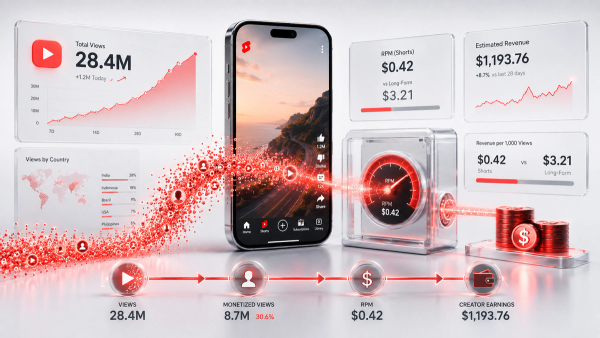
Shorts monetization is the revenue stream attached to the Shorts format: vertical videos up to 60 seconds that appear in the dedicated Shorts feed and in the Shorts shelf across YouTube. When a channel is in the YouTube Partner Program (YPP) and its Shorts are eligible, YouTube plays ads in between Shorts as viewers scroll the feed, and the creator earns a share of the pooled ad revenue attributed to their eligible views. This is the key mental shift. Long-form videos earn from skippable and non-skippable ads that play before, during, and after the video itself. Shorts have no such ad placements inside the video. The monetization happens around the feed, which is why the model had to be built differently from long-form. Understanding that difference explains why Shorts pay far less per view than long-form: every short-form view splits a shared, music-adjusted pool instead of triggering its own ad auction. Monetization only applies to eligible views, and eligibility depends on content originality, which we cover next. Views of ineligible Shorts still count toward your channel's reach and your headline view totals, but they do not count toward your share of the revenue pool. That gap between total views and monetizable views is the single biggest reason creators misread their own Shorts numbers.
How the Shorts Revenue Pool Works
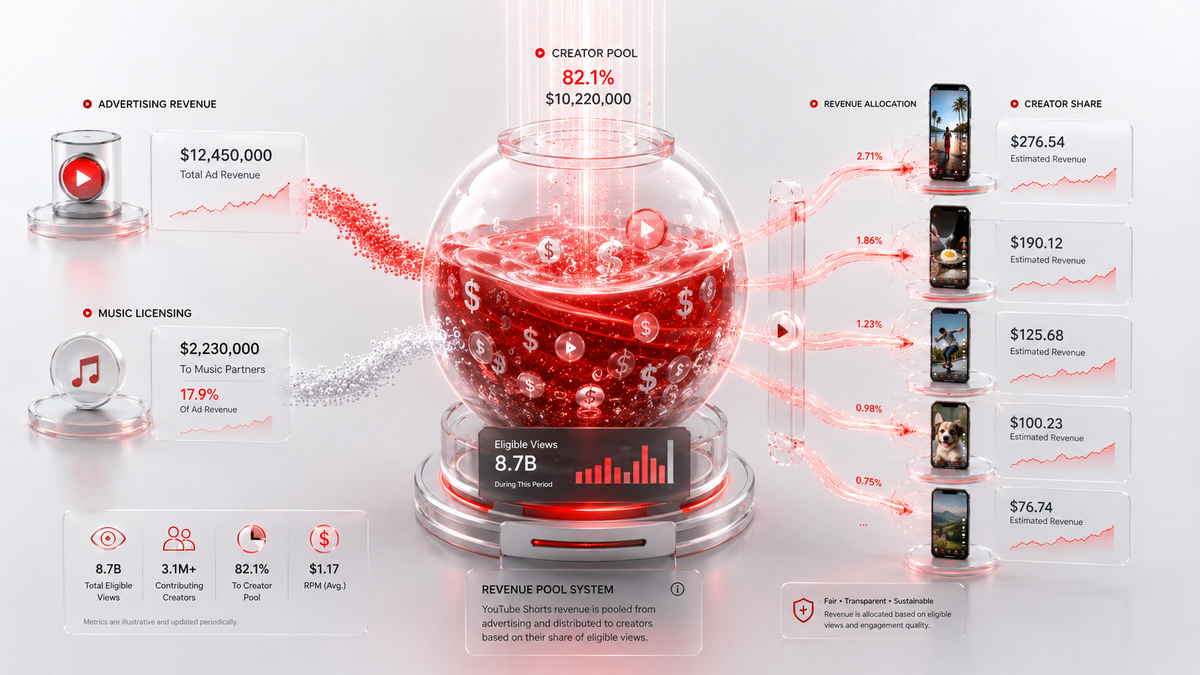
The pooled model is best explained as a five-step flow. First, advertisers bid to run ads in the Shorts feed, and viewers see those ads as they swipe between Shorts. Second, all of that ad money from the Shorts feed is collected into one pool shared across the platform. Third, YouTube deducts music licensing costs from the pool, because many Shorts rely on licensed music and those licenses must be paid before creators see anything. Fourth, YouTube calculates your share of the pool based on how many of your views were eligible compared with all eligible Shorts views worldwide. Fifth, creators keep 45% of the allocation attributed to their views. A worked example makes it concrete. Imagine the eligible pool for a month is $100 million and your channel accounted for 0.01% of all eligible Shorts views that month. Your allocation would be 0.01% of the pool, or $10,000, and you would keep 45% of that: $4,500. Raise your share of eligible views to 0.05% and the same math produces roughly $22,500, assuming the pool stays at $100 million. These numbers are illustrative, not a forecast, but they capture the actual formula YouTube uses. What matters operationally is that your earnings are driven by your proportion of total eligible views, not by a fixed per-view price. That is why one Short with 500,000 views can pay more or less than another with 300,000 views, depending on when it ran, where the views came from, and how the global pool performed that month. The pool is a moving target, and any single number you read about Shorts payouts is an average, not a rate.
What Counts as a Valid, Monetizable Short?
Not every view counts toward the pool. YouTube's monetization policies require Shorts to be original and to qualify as advertiser-friendly in the same broad sense that long-form content must. The big three rules creators trip on:
- No unedited third-party clips. Re-uploading movie trailers, TV segments, sports highlights, or other channels' footage without substantial transformation makes a Short ineligible. A tiny, unedited 15-second clip inside a 60-second Short can still disqualify the whole video.
- No full-length copyrighted music on top. Using the standard Shorts music library is fine, and those licenses are paid from the pool. Capping an otherwise original Short with a full copyrighted song you do not have rights to can pull the monetization from that video.
- No reused or mass-produced content. Compilations, slideshows of other people's content, or near-duplicate uploads across channels risk being flagged as reused content, which affects eligibility channel-wide rather than just for a single video.
A practical self-check: would this Short exist without the clip I borrowed? If the answer is no, the Short is probably not eligible. Shorts that are clearly original, with your footage, your voiceover, your editing, and your text overlays and transitions, clear the bar comfortably. Views on ineligible Shorts still add to your view totals, so a channel can look like it is doing well while its monetization math is much smaller than the headline numbers suggest. Check each video's monetization status icon in YouTube Studio rather than assuming eligibility, especially for Shorts built around trending sounds or popular clips.
The 45% Creator Share Explained
Long-form creators keep 55% of ad revenue and YouTube keeps 45%. Shorts flip that structure: creators keep 45% of their pool allocation, and YouTube's 55% covers both the platform and music licensing. The split is one of the most common sources of confusion, because the 45% is sometimes quoted as if creators only receive 45% of something much smaller. In practice, YouTube handles the deductions first, and the 45% applies to your remaining allocation. The practical consequence is that short-form earnings per view are structurally lower than long-form even before you account for the difference in ad value. Long-form can carry multiple ad breaks and plays in a bidding environment tailored to your audience. Shorts split a pool after licensing costs. Both models coexist, and many of the healthiest creator incomes come from Shorts feeding viewers into long-form rather than Shorts funding a channel alone. If you want the full picture of how the two compare, our Shorts vs long-form guide walks through the numbers side by side.
Typical Shorts RPM in 2026
RPM is revenue per 1,000 views, and for Shorts the honest range is low. In 2026 most creators see a Shorts RPM between $0.03 and $0.15, with the most common values in the $0.04 to $0.10 band. US and UK-heavy audiences tend toward the top of that range; viewers from developing markets push it lower. A $0.08 Shorts RPM is not a bad outcome; it is a typical outcome. In headline terms, a million Shorts views at a $0.08 RPM equals roughly $80. The range of $50 to $150 per million views covers most creators, with occasional spikes in high-demand months. If you have read that Shorts pay nothing, the accurate version is that Shorts pay little per view, but they scale with volume and they feed the rest of your channel. Our deeper Shorts RPM guide covers what moves that number and how to raise it.
Shorts Monetization Eligibility Paths
Before any of this applies, the channel must be in the YouTube Partner Program. In 2026 there are two tiers and two distinct routes. The full tier requires 1,000 subscribers plus either 4,000 public watch hours in the past 12 months or 10 million Shorts views in the past 90 days. That 90-day Shorts route is the fastest single-format path to full monetization YouTube has ever offered, which is why the 10 million view milestone gets so much attention. The early-access tier targets channels below 1,000 subscribers. It requires 500 subscribers, three public uploads in the last 90 days, and either 3,000 watch hours or 3 million Shorts views. Early access unlocks fan funding such as Super Thanks, channel memberships, and Super Chat, but not ad revenue. It is a meaningful start, and the Shorts view threshold is reachable long before most channels hit the full tier. Expect a monetization review that can take around a month, and remember that ad earnings only pay out once your balance crosses the $100 AdSense threshold. If you are tracking progress toward either tier, the Thumbix Monetization Progress Calculator is the right companion, and our YouTube Monetization Requirements 2026 article breaks the eligibility rules down in full.
How Revenue Shows Up in YouTube Studio
Once you are monetized, your Shorts revenue appears in YouTube Studio under Analytics and then Revenue. The dashboard shows estimated revenue, RPM, and views for the period you select. For Shorts specifically, Studio shows a Shorts RPM figure that reflects the pooled allocation with your 45% share already applied. Two things surprise most creators. First, the numbers lag: estimated revenue for a given day can keep adjusting for weeks as the pool and view validation settle. The figure you see on day three is rarely the figure on day 45. Second, the revenue report is an estimate of your share of the pool, not a ledger of individual ad payments, because there is no individual ad to point at. If your estimated revenue looks low, check the Shorts RPM shown rather than the view count, and remember that only eligible views count toward the pool. Payout still runs through AdSense with the $100 threshold, and the money lands on the same schedule as long-form revenue. Keep your payout settings current in AdSense or the balance simply accumulates until you fix it.
Shorts Earnings at Different View Counts
The table below shows estimated earnings at different view counts across three plausible Shorts RPMs. The middle column matches a typical channel; the low and high columns show the realistic spread. All figures are estimates and will vary by audience and month.
- 100,000: $4, $8, $15
- 500,000: $20, $40, $75
- 1,000,000: $40, $80, $150
- 5,000,000: $200, $400, $750
- 10,000,000: $400, $800, $1,500
Reading the table honestly matters. Ten million Shorts views qualifies a channel for full YPP via the 90-day route, and at a typical RPM it produces roughly $400 to $800 of estimated Shorts revenue. That is not a life-changing payday on its own, and it should not be the goal. The value compounds when those views pull viewers into long-form videos, which earn at a multiple of the Shorts rate, and when the channel converts the audience into memberships, fan funding, and brand deals. The Shorts-to-long-form loop is the actual business model for most successful short-form-first channels in 2026.
How to Use the Thumbix Shorts Earnings Calculator
The fastest way to sanity-check any of these numbers is the free Thumbix Shorts Earnings Calculator. Enter the views a Short earned or expect it to earn, choose or enter a Shorts RPM, and the calculator returns estimated revenue for that video. It also works in reverse: tell it how much you want a Short to earn and it shows how many views that requires at a given RPM, which is far more useful when you are planning a series. Pair it with the Thumbix RPM Calculator to back out a measured RPM from revenue and views you already know, and with the Thumbix YouTube Money Calculator to see how Shorts fit into total channel income once you add long-form views and RPM. All three are free, and they operate on the same transparent estimates used throughout this article, so the outputs stay consistent with everything you have read here.
Realistic Expectations: The Honest Truth
The honest truth is that Shorts monetization on its own does not replace a salary for the vast majority of creators. At a typical $0.04 to $0.10 RPM, even a million-view month generates roughly $40 to $100. Treat Shorts as a discovery and audience-building machine first and a revenue stream second. The channels that actually make money combine Shorts with long-form videos, memberships, brand deals, and products. Volume is also a reality of the format. On most channels, one Short out of ten carries the majority of the views, and the only reliable way to find winners is to ship regularly and kill what flops. Estimates will always vary; the ranges in this article are the realistic 2026 envelope, not a guarantee. Plan with the bottom of the range, celebrate the top, and never mistake a single viral Short for a sustainable channel by itself. Track your 90-day progress with the Thumbix Monetization Progress Calculator so the goal stays visible.
Final Takeaway
Shorts monetization in 2026 is a pooled-revenue model: ads in the Shorts feed fund a global pool, music licensing is deducted, your eligible views decide your share, and you keep 45% of that allocation. Typical RPM runs $0.03 to $0.15, a million Shorts views generally returns $50 to $150, and the 90-day, 10-million-views path to full YPP is real. Check the originality rules before you upload, read your Studio numbers as estimates rather than guarantees, and use the Thumbix Shorts Earnings Calculator to plan around numbers you actually control.
Frequently Asked Questions
How does YouTube Shorts monetization work in 2026?
Ads run between Shorts in the Shorts feed, the revenue goes into a global pool, music licensing is deducted, and creators get a share based on their eligible views. Creators keep 45% of that allocation.
How much do YouTube Shorts pay per 1,000 views?
Typically $0.03 to $0.15 per 1,000 Shorts views, with $0.04 to $0.10 most common. That means roughly $50 to $150 per million Shorts views for most creators. These are estimates that vary by audience.
What counts as a monetizable Short?
An original, advertiser-friendly Short. Unedited third-party clips, full copyrighted songs you don't own, and reused or mass-produced content are ineligible, and those views don't count toward your pool share.
Do creators keep 45% of Shorts revenue?
Yes. Creators keep 45% of their share of the pool after music licensing costs are deducted. Long-form pays 55% to creators, which is why Shorts RPM is structurally lower.
How many views do Shorts need to qualify for the YouTube Partner Program?
Full YPP needs 1,000 subscribers plus either 4,000 watch hours in 12 months or 10 million Shorts views in 90 days. The early-access tier needs 500 subscribers plus 3,000 watch hours or 3 million Shorts views.
Why does my Shorts revenue look lower than my view count suggests?
Only eligible views count toward the pool, revenue numbers are estimates that adjust for weeks, and Shorts pay per view at a much lower rate than long-form. Check the Shorts RPM in Studio rather than the view count.
How do I get paid from Shorts?
Revenue goes to your AdSense balance like long-form earnings, and you get paid once the balance passes the $100 payout threshold.