
Table of Contents
- Introduction
- CPM vs RPM: The Setup You Need First
- What Is a Good YouTube CPM in 2026?
- CPM Benchmarks by Niche
- CPM Benchmarks by Country
- CPM Benchmarks by Season
- What Actually Drives Your CPM
- Video Length and Ad Density
- How to Increase Your YouTube CPM
- When Low CPM Is Fine
- Tools to Track Your CPM and RPM
- Frequently Asked Questions
- A Worked Example: From CPM to Real Earnings
- How to Find Your CPM and RPM in YouTube Studio
- Mistakes That Quietly Suppress Your CPM
- CPM Isn't Everything: Think in Total Revenue
- CPM Benchmarks by Video Length
- Conclusion
A good YouTube CPM in 2026 is usually $4–$8 for long-form, with finance and business niches reaching $10–$25. Here's why it varies and how to raise it.
Introduction
Every creator eventually opens YouTube Studio, stares at the numbers, and asks the same question: "Is this CPM good?" It's a fair question with a frustratingly contextual answer. A CPM that's great for a gaming channel would be disappointing in finance. A CPM that's strong in January can look weak in the summer. Here's the honest 2026 answer: for long-form content, a typical good YouTube CPM is between $4 and $8. Finance, business, and software channels routinely see $10 to $25. Gaming and entertainment often run $1 to $4. And those ranges move with country, season, and content quality. This guide walks through the benchmarks, what drives them, and — most importantly — what you can actually do to push your number up.
CPM vs RPM: The Setup You Need First
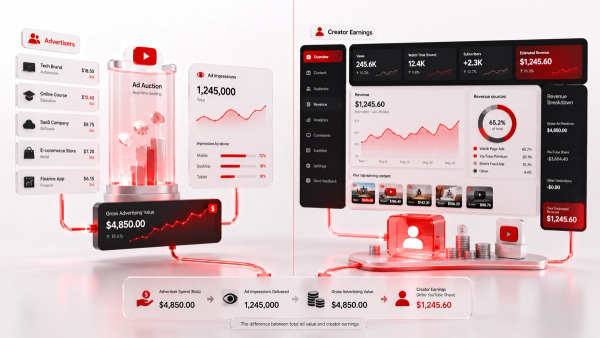
Before any benchmark is useful, get the distinction straight. CPM is what advertisers pay for 1,000 ad impressions. RPM is what you earn per 1,000 views after YouTube's revenue share and your fill rate. They are not the same number, and they shouldn't be compared directly. A finance channel might have a $15 CPM but a $9 RPM because only a fraction of views serve ads and YouTube takes a share. When someone says "my CPM is terrible," they're often looking at RPM and blaming the wrong metric. If you're evaluating your earnings, RPM is the number that matters. If you're evaluating how much advertisers value your audience, CPM is the interesting one.
What Is a Good YouTube CPM in 2026?
For long-form content in most niches, a healthy CPM lands between $4 and $8. That's the "typical good" zone — above the low end for gaming and entertainment, below the elite finance tier.
- Below $2: common for gaming, entertainment, and Shorts-adjacent content
- $2–$4: the low-to-mid zone many entertainment and lifestyle channels see
- $4–$8: the typical good range for general long-form
- $8–$15: strong — common in tech, education, and business
- $15–$25+: elite — finance, insurance, SaaS, and high-value professional content
Anything in the $4–$8 range means advertisers value your audience well above average. Getting into $10+ means you've built an audience that competes for high-priced ad inventory.
CPM Benchmarks by Niche
- Personal finance: $12–$30
- Insurance and legal: $15–$35
- Business and investing: $10–$25
- SaaS and software: $8–$18
- Real estate: $8–$20
- Education: $5–$12
- Health and wellness: $4–$10
- Travel: $3–$8
- Lifestyle and DIY: $3–$7
- Technology reviews: $5–$12
- Entertainment: $1–$5
- Gaming: $1–$4
These are estimates, not guarantees — your audience country and retention shift you up or down within each band.
CPM Benchmarks by Country
Advertisers pay differently depending on where viewers are. US, UK, Australia, Canada, and much of Western Europe command premium CPMs — often 3 to 10 times higher than viewers in emerging markets. Two identical videos, one pushed to a US audience and one to an Indian audience, can produce wildly different CPMs. You don't need to chase a specific country — that usually backfires. But understanding your audience geography explains a lot of the difference between your CPM and someone else's.
CPM Benchmarks by Season
CPM moves with advertiser budgets. Q4 (October through December) is the peak — retailers and brands spend heavily ahead of the holidays, and CPMs across most niches climb. January typically stays strong. Spring and summer often soften as budgets tighten, and September picks up again. A channel that plans its biggest videos around the Q4 window can meaningfully lift its average CPM for the year. It's one of the few levers that doesn't require changing your content or audience.
What Actually Drives Your CPM
The four big drivers:
- Niche. Finance and business audiences are worth more to advertisers because viewers of that content are often in-market for expensive products and services.
- Audience country. Higher-income geographies command higher bids.
- Audience demographics. Age, income, and intent signals affect what advertisers will pay to reach a viewer.
- Demand. Seasonal budgets and advertiser trends move CPMs up and down independently of your content.
Video Length and Ad Density
Longer videos allow more ad placements, which raises both ad impressions per viewer and your CPM. A 10-minute video can host mid-roll ads that a 3-minute video never could. In 2026, creators who move from 5-minute content to 10–15 minute content often see their RPM climb substantially for the same audience — not because the CPM changed, but because each viewer contributed more ad impressions. Ad placement quality matters too. Well-spaced, manually placed mid-rolls respect retention while adding impressions. Blanket automatic placements can hurt watch time.
How to Increase Your YouTube CPM
You can't directly set your CPM, but you can influence it:
- Go deep on a valuable niche. Content about money, business, and software attracts high-CPM advertiser pools. You don't have to be a finance channel — even finance-adjacent content (side hustles, investing tools, business tech) rides the same demand.
- Target high-CPM geographies naturally. Speak to the language and topics of US/UK audiences if that fits your content; don't fake an audience.
- Lengthen high-retention videos. More watch time and more placements lift RPM and average CPM.
- Keep quality high enough for brand-safety. Advertisers bid less on channels with erratic uploads or borderline content. Consistency signals safety.
- Publish your biggest content in Q4. Leverage the seasonal peak.
- Improve retention. Advertisers and YouTube both reward content viewers actually finish.
- Build an audience profile that matches high-paying intent. Tutorials and comparison content signal purchase intent better than pure entertainment.
When Low CPM Is Fine
Low CPM isn't automatically a failure. A gaming channel with a $2 CPM can out-earn a finance channel if it pulls 10 times the views — and gaming content has a far larger audience. Low-CPM niches often grow faster, which means more subscribers, sponsors, and opportunities. Measure value by total revenue and growth, not by a single rate.
Tools to Track Your CPM and RPM
The Thumbix CPM Calculator converts CPM and fill rate into estimated RPM so you can compare the advertiser-side and creator-side numbers. The RPM Calculator works backward from earnings to your actual rate. And the YouTube Money Calculator ties it together, projecting what your views produce at your current RPM. For benchmarks by country and niche, cross-check your Studio data against this guide's ranges.
A Worked Example: From CPM to Real Earnings
Put the numbers together. A channel with a $10 CPM and a 55% fill rate keeps about $5.50 per 1,000 views before YouTube's revenue share. Apply the standard long-form share and the RPM lands somewhere around $3.50–$5.50 depending on placements and geography. On a 500,000-view month, that's roughly $1,750–$2,750 from ads — versus the $5,000 the raw CPM would suggest. The difference isn't a platform glitch; it's the gap between what advertisers pay and what creators receive. Running the full chain — CPM, fill rate, share — is the only way to predict a check.
How to Find Your CPM and RPM in YouTube Studio
YouTube gives you both numbers, but they live in different places:
- RPM: the Monetization tab in YouTube Analytics shows your estimated revenue and RPM for long-form videos. This is your honest earnings rate.
- CPM: YouTube's playback-based CPM appears in the same monetization reports. It measures advertiser cost per 1,000 monetized playbacks — the closest you get to the true CPM in Studio.
- Fill rate: compare revenue between videos with similar audiences; low-fill videos look worse even when the audience value is fine.
Pull these from Studio each month and keep your own table. The moment you can see your CPM, fill rate, and RPM side by side, the reasons behind your earnings stop being mysterious.
Mistakes That Quietly Suppress Your CPM
A few habits drag CPM down without announcing themselves:
- Weak retention. Advertisers pay for viewers who watch, not viewers who click away. High early-exit rates depress your value.
- Inconsistent uploads. A channel that vanishes for months looks risky to advertisers and gets bid on less.
- Clickbait packaging. Titles and thumbnails that promise more than the video delivers train viewers to leave, and engagement metrics follow.
- Ignoring brand-safety signals. Swearing, controversy, or reused clips push cautious brands to cheaper inventory.
- Not cleaning up old underperformers. Videos that tank retention or engagement can weigh on a channel's overall attractiveness.
Fix these and your CPM rises on the demand side, not just from niche luck.
CPM Isn't Everything: Think in Total Revenue
A finance channel with a $20 CPM and 50,000 views a month earns $1,000 in ads. A gaming channel with a $2 CPM and 2 million views a month earns $4,000 — four times more from a "worse" CPM. Total revenue is what pays the bills, and total revenue is views multiplied by RPM. If chasing a high CPM means making content you can't sustain or audiences you can't reach, you've optimized the wrong number. Pick the niche you can actually win, keep CPM awareness in your back pocket, and measure your channel by what lands in the account — not by the size of a single rate. And when you do check the rate, remember the season. A CPM measured in a quiet summer month is not the same as one measured in Q4. Judge your numbers across a full year before you conclude anything about your audience's worth.
CPM Benchmarks by Video Length
Video length shifts the practical value of your CPM. A 3-minute video serves at most a pre-roll, so its effective revenue per view is capped low. An 8-minute video can serve one or two mid-rolls, multiplying ad impressions per viewer. A 15-minute video gives you room for several well-spaced placements. The pattern explains why creators who move from short clips to 8–15 minute content often watch their earnings climb without any change to their audience: same CPM, more impressions per view. If your CPM looks fine but your earnings feel low, length is the first place to look.
Conclusion
A good YouTube CPM in 2026 is contextual — $4–$8 for most long-form channels, $10–$25 for the high-demand niches, and $1–$4 at the low end. What matters more than the benchmark is understanding what drives your number: niche, country, season, and content quality. Work those levers, plan around Q4, lengthen what viewers finish, and your CPM will trend where it should. Curious where you actually stand? Convert your numbers with the free Thumbix CPM Calculator and see what your audience is truly worth to advertisers.
Frequently Asked Questions
What is a good YouTube CPM in 2026?
For long-form content, typically $4–$8. Finance, insurance, and business niches run $10–$25+, while gaming and entertainment often sit at $1–$4.
Is $10 CPM good on YouTube?
Yes. A $10 CPM is well above average and is typical for tech, education, and business audiences.
What is the difference between CPM and RPM?
CPM is what advertisers pay per 1,000 ad impressions. RPM is what you earn per 1,000 views after YouTube's revenue share and fill rate. RPM is always lower.
Why is my YouTube CPM so low?
The most common causes are a low-demand niche, viewers in lower-CPM countries, weak retention, or off-peak seasonality.
Does longer video increase CPM?
Longer videos increase ad impressions per viewer, which raises RPM and average CPM. Ten-minute videos can host mid-rolls that shorter videos can't.
What niche has the highest YouTube CPM?
Insurance and legal lead, followed by personal finance, business, and software — audiences that are in-market for high-value products and services.