
Table of Contents
- Introduction
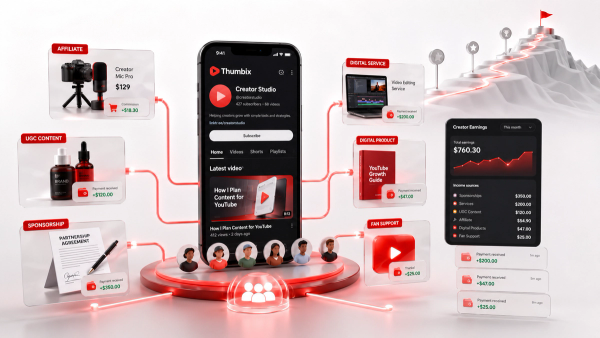
- The 10 Side Hustles at a Glance
- Thumbnail Design Services
- UGC Creation
- Channel Management
- Affiliate Marketing
- Memberships and Fan Funding
- Digital Products
- Sponsorship Brokering
- Faceless Channels
- Shorts Repurposing
- Coaching and Consulting
- How to Pick the Right Side Hustle
- Frequently Asked Questions
- Final Takeaway
There are ten genuinely realistic ways to make money around YouTube in 2026 — and only a few of them require you to grow a channel at all. Here they are, ranked by effort, speed, and payoff.
There are two ways to look at YouTube in 2026. One is the way the headlines frame it: a billion-dollar platform where a handful of channels earn fortunes. The other is the way it actually works for most people — a skills incubator where the real money lives in what you can do around video, not just in the ads attached to it. Almost every hustle in this list is something one person can start this month with a phone, a computer, and a weekend of setup. None of them require you to blow up, and several pay before you ever reach monetization.
Introduction
Let's set expectations honestly before the rankings. No YouTube side hustle is passive in the first six months, and none pays the same for the same effort. What changes everything is transferable skill — thumbnail design, editing, storytelling, analytics, outreach — and you can build each of those in roughly thirty days of deliberate practice. The ten hustles below are ranked for the balance of three things: how quickly they can pay, how much they can realistically earn in 2026, and how much daily work they demand. Every figure is an estimate based on current market data, not a promise of income. Treat the ranges as a spread, not a target; your personal result will sit somewhere inside them.
The 10 Side Hustles at a Glance
Here is the short version before we dig into each one:
- Thumbnail design services: Low, 2-4 weeks, $15-$75 per thumbnail, Designers, beginners
- UGC creation: Low, 1-3 weeks, $50-$300 per video, Anyone with a phone
- Channel management: Medium, 1-2 months, $500-$5,000 per month, Organized generalists
- Affiliate marketing: Low, 1-3 months, $0-$2,000+ per month, Review channels, blogs
- Memberships and fan funding: Medium, 3-6 months, $50-$5,000 per month, Established communities
- Digital products: Medium, 2-4 months, $100-$10,000+ per launch, Teachers, experts
- Sponsorship brokering: Low, 2-6 weeks, 10%-20% of deal value, Connectors, networkers
- Faceless channels: High, 4-8 months, $0-$2,000+ per month, Patient, consistent
- Shorts repurposing: Medium, 3-6 months, $100-$1,000 per month, Editors, remixers
- Coaching and consulting: Medium, 1-2 months, $50-$500 per session, Experienced creators
The spread between the low and high end of each row is mostly explained by niche, audience country, and how consistent you are. A finance niche pays more than a gaming niche on almost every row, because advertisers pay more to reach finance viewers.
Thumbnail Design Services
The most underrated entry point on the list. Creators at every size need thumbnails, and most of them are bad at making their own. A clean 1280x720 thumbnail with a readable face, strong contrast, and a single focal point sells for roughly $15 to $75 each at the lower end of the market, and agencies and established creators pay more for reliability. Monthly retainers — five to ten thumbnails a week — are the better financial model, because they convert a one-off job into recurring income you can plan around. You do not need to be a trained designer. You need composition sense, a tool like Figma or Canva, and a delivery workflow that outputs files at the exact correct size with safe zones respected. That last part is exactly why the Thumbix Thumbnail Resizer exists: it produces correctly scaled 1280x720 files in seconds, and the safe-zone and aspect-ratio checkers catch the mistakes that frustrate clients. Freelance thumbnail work is also the natural on-ramp to the other hustles on this list, because it drops you inside other creators' businesses where you will constantly spot sponsorship, management, and product opportunities. Our full guide on thumbnail design as a freelance service covers portfolios, pricing, and client outreach step by step.
UGC Creation
UGC — user-generated content — is the closest thing the creator economy has to a paid apprenticeship. Brands pay ordinary people to film short, authentic video ads for their products, and the rates are solid: beginners typically earn $50 to $300 per video, intermediate creators $300 to $750, and experienced ones $750 to $2,000 or more. There is no subscriber minimum and no following required. You are paid for production skill and authenticity, not reach. Creators who treat UGC as a business and build a repeat-client roster often land around $48,000 to $72,000 a year. If you have ever made a YouTube video, you already know how to hook someone in three seconds, how to structure a short script, and how to light a face. Those are exactly the skills brands are buying. Build three sample videos in niches you actually use, set a rate from the ranges above plus usage-rights pricing, and start pitching. UGC is the fastest time-to-first-dollar on this list for good reason.
Channel Management
Channel management is where transferable YouTube skills become a genuine service business. Channels that earn real money are usually run by creators who are great on camera and bad at operations. That gap is your product. A channel manager handles strategy, SEO, scheduling, thumbnail direction, community management, and reporting. Prices scale with scope: a virtual-assistant-style arrangement runs roughly $1,600 a month, full-service management sits around $1,500 to $5,000 a month, and agencies charge $10,000 or more for multi-channel clients. You land the first client with a free audit, not a pitch deck. Pull their upload schedule, their views per subscriber, and their milestone trajectory, and hand them a one-page plan. Channel management is a crowded field, so the differentiator is data. A manager who can diagnose a channel's upload frequency, views-per-subscriber ratio, and next subscriber milestone with the Thumbix Upload Frequency Calculator, Views Per Subscriber Calculator, and Subscriber Milestone Calculator walks into a first call already having done the work. A manager who promises 'growth' in the abstract does not.
Affiliate Marketing
Affiliate marketing is the classic zero-capital hustle, and it compounds with every other entry on this list. The economics favor digital and software products: SaaS programs commonly pay 20% to 65% recurring commissions, finance programs pay $50 to $200 per approved lead, and Etsy sits around 4% to 8% with a 30-day cookie, while Amazon Associates is thinner at 1% to 10% (usually 3% to 4.5%) with a 24-hour cookie. Most third-party programs have no subscriber minimum at all, which makes them ideal for a channel that has not monetized yet. The math is what beginners miss. A video with 5,000 views and a 2% click-through to an affiliate link gets about 100 clicks, and a decent 3% to 5% conversion gives three to five sales. At a $40 average order and a 30% commission, that is $36 to $60 from a single video that cost an afternoon. Scale it across a library and it compounds quietly. The Thumbix YouTube Money Calculator is useful here for reverse math: decide what you want to earn per video and work backward to the views and conversions required.
Memberships and Fan Funding
Once you reach the 2026 early-access YPP tier — 500 subscribers, three public uploads in 90 days, and either 3,000 watch hours or 3 million Shorts views — YouTube unlocks fan funding: memberships, Super Thanks, Super Chat, and Super Stickers. This is direct income. You keep 70% of membership revenue after YouTube's cut, so a $4.99 tier nets about $3.49 per member per month, and typical channels convert 0.5% to 2% of subscribers into members. At 100,000 subscribers, 1% conversion, and a $5 average, that is roughly $5,000 a month before anyone watches an ad. Memberships are a patience play — meaningful income arrives once you have a community that shows up weekly — but they are also the first revenue stream most creators actually get, because fan funding unlocks before ad revenue under current rules. One practical note: iOS in-app signups take an extra 30% through Apple, so always steer viewers to the web for signups.
Digital Products
Selling digital products turns your knowledge into something you make once and sell many times. Templates, presets, Notion setups, spreadsheets, courses, and guides all qualify. The appeal is margin: a $49 template costs nothing to reproduce, and the channels doing this well use YouTube as the trust layer, not the checkout. Launch campaigns routinely gross $100 to $10,000 or more depending on audience size and price. A small audience can absolutely convert, because conversion runs on trust and specificity, not scale. A channel with 2,000 subscribers who all showed up for one narrow problem will outsell a broad channel with 200,000. Price to the outcome, not the hours: a $99 guide that saves a beginner a month of trial and error is cheap. The Revenue Goal Calculator is the planning tool here — put in a target, your typical views, and a conversion assumption, and it tells you how many launches you need and at what price point.
Sponsorship Brokering
Every brand that wants YouTube reach needs creators, and plenty of creators do not know their own value. A sponsorship broker connects the two and takes a cut, typically 10% to 20% of deal value. You do not need your own channel. You need a contact list, a clean media kit, and honest channel data. The broker's real job is pricing. A creator's baseline rate is roughly (average views over the last 90 days divided by 1,000) times the niche CPM. Finance and B2B SaaS sponsors pay $40 to $80 per 1,000 views, tech and education $20 to $40, and gaming as low as $3 to $12. Because brands usually open negotiations 30% to 40% below their budget, the broker who pushes back gets paid twice — once on the deal and once in reputation. Use the Thumbix Sponsorship Calculator and Brand Deal Calculator to build defensible rate cards for every creator you represent. A broker with solid numbers closes more deals than one with enthusiasm.
Faceless Channels
Faceless channels are the highest-effort, highest-variance entry on this list, and the one most overhyped online. The realistic arc looks like this: $0 to $300 in months one through three, $300 to $1,500 in months four through six, and $2,000 or more a month by months nine through twelve when things are going well. Reaching $1,000 a month at a $5 RPM requires roughly 200,000 monetized views a month — a real target, not a fantasy. Finance-focused faceless channels can see RPMs of $8 to $20 or more, which changes the math dramatically. The trap is the online hype that sells faceless channels as passive income. A realistic first-year outcome is often something like $700 earned from about 777,000 views — and that is not a failure, because the consistent-posting grind usually takes 60 to 180 days just to reach monetization. Remember that ads are typically only 30% to 50% of a successful faceless channel's income; affiliates, sponsorships, and products make up the rest. The startup cost, roughly $30 to $100 a month in tools, is the cheapest part of it.
Shorts Repurposing
Repurposing long-form content into Shorts is the fastest content engine on YouTube, and it monetizes through the Shorts pool: creators keep 45% of their allocated pool share, with typical Shorts RPM around $0.03 to $0.15 per 1,000 views. On its own that is pocket money. The real value is the funnel — a Short that pulls viewers into a long-form video feeds ad revenue, affiliate links, memberships, and brand attention all at once. Treat Shorts repurposing as a discipline with rules: cut the hook first, land the payoff within 60 seconds (the current maximum), and verify every export before upload. The Shorts Duration Calculator on Thumbix checks your clip length against the limit, and the Shorts Earnings Calculator estimates the pool side of the equation so you can compare it honestly against your long-form RPM. A full workflow for turning one video into multiple income streams lives in our repurposing guide.
Coaching and Consulting
Once you have results — even small ones — people will pay to skip the trial and error you survived. Creator coaching typically runs $50 to $500 a session depending on your experience and the stakes involved. The 2026 trend is micro-consulting: a paid 30-minute audit of a channel's thumbnails, titles, and packaging for a flat fee. It is the natural high-margin extension of everything else on this list, because the asset you sell is judgment, and every hustle above has been building yours.
How to Pick the Right Side Hustle
You do not need all ten. You need the one that matches your constraints. Full-time job with two free hours a night? Choose a short time-to-first-dollar — UGC, thumbnails, or affiliate links on an existing channel. Want an eventual full-time income with a real ceiling? Channel management and faceless channels scale higher but pay later. Already have an audience of any size? Memberships and digital products beat everything else on margin. Whatever you choose, run the numbers before you commit. Put realistic view counts into the YouTube Money Calculator, price a sample sponsorship with the Sponsorship Calculator, and sanity-check a rate card against a brand budget with the Brand Deal Calculator. Five minutes with those tools turns 'maybe I should try something' into an actual decision with a number attached.
Final Takeaway
Nobody needs permission to start a YouTube side hustle, and nobody needs a big channel either. The ten options above range from pure freelance work that pays this month to long-term channel building that pays in a year, and the honest strategy is to pick one short-fuse hustle for cash flow and one long-term play for leverage. Keep the numbers honest, price your work with real data instead of vibes, and let the compounding start.
Frequently Asked Questions
What is the easiest YouTube side hustle to start in 2026?
Thumbnail design and UGC creation are the lowest barrier to entry. Both need only a phone or computer, a short skill ramp, and no subscriber minimum, with beginners earning roughly $15 to $75 per thumbnail or $50 to $300 per UGC video.
Can I make money on YouTube side hustles without any subscribers?
Yes. UGC, thumbnail design, channel management, affiliate marketing, and sponsorship brokering all work with zero subscribers. Only memberships and fan funding require the early-access YPP tier.
How much can a YouTube side hustle realistically earn per month?
Most people earn a few hundred dollars a month in their first year. At the realistic ceiling, channel management and well-run faceless channels reach $2,000 to $5,000 a month, and digital product launches can gross $10,000 or more per launch.
Which YouTube side hustle pays the fastest?
UGC creation typically pays fastest — within one to three weeks if you pitch with a strong three-video portfolio. Beginners usually earn $50 to $300 per video.
Is a faceless channel a good side hustle for a beginner?
It works, but it is the slowest and highest-variance option here. The realistic arc is $0 to $300 in months one through three and $300 to $1,500 in months four through six, with monetization usually taking 60 to 180 days.
How do I price my YouTube-related services?
For sponsorship pricing use (average views over 90 days / 1000) x niche CPM. For services, price on the outcome you deliver and the market rate in your niche, and raise prices as you collect testimonials.
Do I need to be good at design to sell thumbnails?
No. You need composition sense, contrast, and a consistent delivery workflow. Tools like the Thumbix Thumbnail Resizer handle the technical sizing and safe-zone checks.
What is the most profitable YouTube side hustle long term?
Digital products and memberships have the best margin because you create once and sell repeatedly. Channel management has the most reliable monthly ceiling at $1,500 to $5,000 or more for full-service clients.