Table of Contents
- Introduction
- Why 1,000 Subscribers Is Not the Real Gate
- The Early-Access YPP Tier (500 Subscribers)
- Fan Funding Before Ad Revenue
- Affiliate Marketing With No Subscriber Minimum
- UGC Work for Brands
- Services Built on YouTube Skills
- Sponsorships for Nano Channels
- Track Your Progress to Both Thresholds
- A Realistic 12-Month Roadmap
- Frequently Asked Questions
- Final Takeaway
The 1,000-subscriber milestone unlocks ad revenue, but it is not the only way to earn. In 2026 you can start making money around 500 subscribers — and even earlier with affiliates, UGC, services, and nano sponsorships.
Ask most people when YouTube starts paying and they will say 'at 1,000 subscribers.' That answer is out of date. In 2026 the YouTube Partner Program has two tiers, and the early-access tier starts at just 500 subscribers and unlocks fan funding — memberships, Super Thanks, Super Chat, and Super Stickers — before you earn a single cent from ads. Beyond YouTube itself, the platforms around it will pay you at zero subscribers: affiliate programs, UGC clients, channel services, and nano-channel sponsorships all ignore your subscriber count entirely. This article walks through every realistic way to earn before the big milestone, plus exactly how to track your progress toward both thresholds.
Introduction
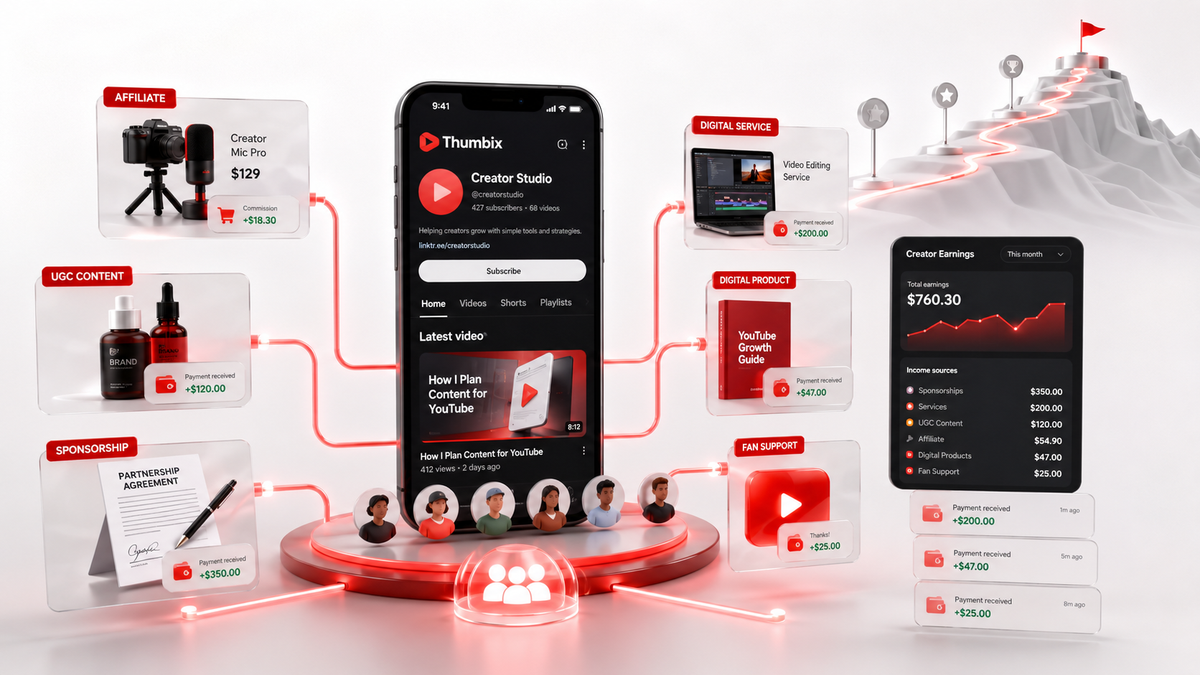
Here is the framing that matters: ad revenue is one stream, and for small channels it is the least interesting one. The creators who earn before 1,000 subscribers do so by selling attention, skill, or trust — not by waiting for YouTube to flip a switch. The early-access tier gets you started on direct fan payments at 500 subscribers. Everything before that comes from affiliate marketing, freelance UGC work, channel services you sell with your YouTube skills, and small sponsorships that brands offer to nano creators. Each has different math, different speed, and different effort, and this guide covers all of them with realistic 2026 numbers.
Why 1,000 Subscribers Is Not the Real Gate
The 1,000-subscriber plus 4,000-watch-hours (or 10 million Shorts views in 90 days) threshold unlocks the full tier and ad revenue. But it is a long, all-or-nothing wait if you treat it as the only goal, and the smarter play is to layer income streams that pay earlier. There are two reasons the full tier is worth pursuing anyway: the long-form revenue split is 55/45 in your favor, and ad money is the most passive of all the streams. But 'passive later' is not a strategy for today. The 2026 early-access tier, plus the non-YouTube income streams, mean your first dollar can arrive at 500 subscribers — or at zero.
The Early-Access YPP Tier (500 Subscribers)
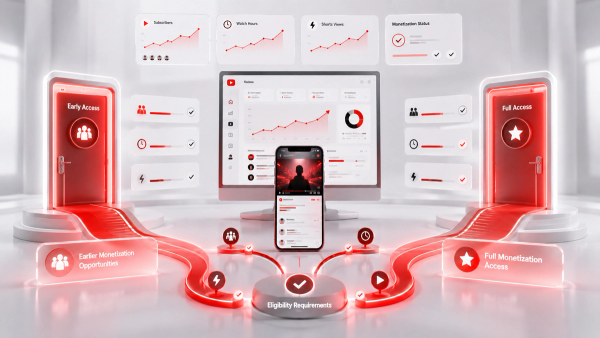
The early-access tier is the biggest change to the Partner Program in years, and most creators do not realize they qualify for it. The requirements: 500 subscribers, three public uploads in the last 90 days, and either 3,000 watch hours in the last 12 months or 3 million Shorts views in the last 90 days. Meeting it unlocks fan funding features but not ad revenue. Monetization review typically takes around a month, and you still need to pass the standard monetization policies before anything pays. Why the tier matters: memberships and Super Thanks are direct, predictable, recurring money, and they arrive long before the full tier. On a channel that is close, those 500 subscribers are far more realistic than 4,000 watch hours feel when you are starting from nothing.
Fan Funding Before Ad Revenue
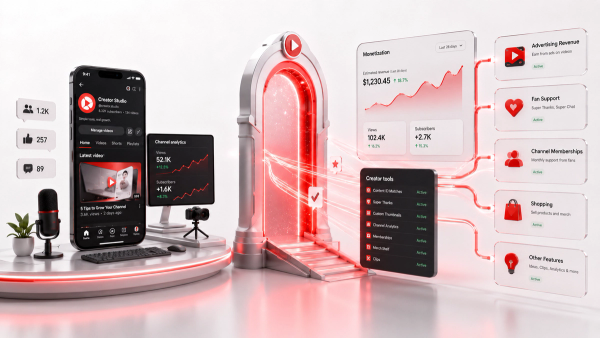
Once the early-access tier is approved, fan funding becomes your YouTube-native income. The economics: memberships pay 70% to the creator, so a $4.99 tier nets roughly $3.49 per member per month. Super Thanks are one-time tips of $2 to $50 on regular videos, also at a 70% share. Super Chat and Super Stickers run $1 to $500 on live streams. Typical subscriber-to-member conversion is 0.5% to 2%, and educational or tutorial channels convert two to three times better than the average. Run that math at small scale: 1,000 subscribers and 1% conversion means about 10 members. At a $5 average, that is roughly $50 a month — not life-changing, but real, and it builds as your community does. Two practical notes: keep your tiers priced low enough that viewers actually click, and always push signups to the web browser, because iOS in-app purchases take an additional 30% cut through Apple. One more distinction worth having straight before you design your tiers: Super Thanks are one-time tips of $2 to $50 on regular, non-live videos, and they are non-refundable — a low-friction way for a viewer to say thanks without a monthly commitment. Super Chat and Super Stickers are live-stream features, priced $1 to $500, that pin a colored message in the chat. Memberships are the recurring option, and they work best when the perks are genuinely useful rather than symbolic: early access, a members-only community post, a monthly Q and A, or behind-the-scenes clips. Even at the early-access stage you can design perks around what your viewers actually want to pay for, and you will learn more in your first month of membership sales than any guide can teach you.
Affiliate Marketing With No Subscriber Minimum
Affiliate marketing is the fastest zero-subscriber income on this list, because almost no third-party program cares about your audience size. The economics favor digital and software: SaaS programs typically pay 20% to 65% recurring commissions, finance programs pay $50 to $200 per approved lead, and Etsy pays around 4% to 8% with a 30-day cookie, while Amazon Associates is thinner at 1% to 10% (usually 3% to 4.5%) with a 24-hour cookie. YouTube's own Shopping affiliate program requires YPP plus a subscriber threshold that has shifted over time and is region-limited — check the current YouTube Help eligibility before relying on it. The beginner-friendly approach: make honest 'how I use this tool' videos or include links in descriptions, and let the videos compound. A single video that lands at 5,000 views, clicks through at 2%, and converts at 4% produces four sales. At a $50 average order and 30% commission, that is about $60 from a video you made once.
UGC Work for Brands
UGC — user-generated content — pays you to make short video ads for brands, and it ignores your subscriber count completely. Beginners typically earn $50 to $300 per video, intermediate creators $300 to $750, and experienced ones $750 to $2,000 or more. No followers required: brands pay for production skill and authenticity, not reach. Full-time UGC income typically lands around $48,000 to $72,000 a year for creators who build a repeat-client roster. Your YouTube skills transfer directly. You already know how to write a three-second hook, structure a short script, frame a face, and grade the footage. Build three sample videos in niches you actually use, set a rate from the ranges above, and add usage-rights pricing (20% to 100% for paid advertising, 50% to 150% for whitelisting) when the brand asks for more than organic placement.
Services Built on YouTube Skills
Every YouTube skill you have is sellable as a service, and services pay this month — no algorithm involved. Thumbnail design is the classic entry: roughly $15 to $75 per thumbnail at the lower end, more as your portfolio grows. Channel management is the bigger ticket: virtual-assistant-style management runs about $1,600 a month, full-service management $1,500 to $5,000 a month, and multi-channel agencies $10,000 or more. Editing, scripts, channel audits, and video SEO are all sellable too. You do not need a big channel to sell these — you need proof of skill and a few testimonials. Your own small channel, even with 300 subscribers, is your portfolio. The clients who hire you are the ones who cannot make the time to do what you already do naturally.
Sponsorships for Nano Channels
Yes, brands sponsor nano channels. Rates for channels under 10,000 subscribers typically run $50 to $500 per video, and the deals exist because nano channels have focused, engaged audiences that reach small but meaningful niches. The formula brands use is (average views over the last 90 days divided by 1,000) times the niche CPM. Finance and B2B SaaS sponsors pay $40 to $80 CPM, tech and education $20 to $40, gaming $3 to $12, and lifestyle $15 to $25. Sponsored Shorts pay roughly $5 to $15 CPM, about half of long-form. A nano channel with 1,500 views per video in the tech niche can reasonably quote $30 to $60 per sponsorship. That is not huge — but it is a real brand conversation happening before the 1,000-subscriber milestone, and it compounds as your view count grows. The Thumbix Sponsorship Calculator and Brand Deal Calculator turn those ranges into a defensible number for your exact channel.
Track Your Progress to Both Thresholds
The single best way to stay motivated and avoid guessing is to track your progress against the actual requirements. The Thumbix Monetization Progress Calculator does exactly this: you enter your current subscriber count, watch hours, and Shorts views, and it shows how close you are to both the early-access tier (500 subs / 3,000 hours / 3M Shorts views) and the full tier (1,000 subs / 4,000 hours / 10M Shorts views), along with the gap in uploads and views you still need. Check it weekly, not daily — daily checking does nothing but create anxiety, while weekly tracking shows real movement. The three-upload requirement is the one people forget, and it is worth watching closely: early access demands three public uploads in the last 90 days, which means a channel that goes dark for a quarter can lose eligibility even with the subscriber and watch-time numbers in place. Keep a small buffer in every column — three uploads rather than exactly three — so a slow week never knocks you out. And remember the thresholds are the floor, not the goal; the same watch hours you are accumulating toward early access continue counting toward the full tier's 4,000, so nothing you earn here is wasted. The progress numbers matter for a second reason: they are also the numbers brands and sponsors ask about. When you quote a sponsorship, your watch hours and engagement are the evidence. Keep them current and your pitch gets stronger every month.
A Realistic 12-Month Roadmap
Here is what the first year looks like for someone starting from zero, using the streams above in the right order. Months one through three: publish consistently, build the skill library, and open an affiliate program with no subscriber minimum. Post affiliate links in descriptions from day one. Meanwhile, send UGC pitches with a three-video portfolio and start selling thumbnails or editing as services. Income: $0 to $300 a month, mostly freelance. Months four through six: you should be closing in on the early-access tier. Keep the affiliate and freelance work going, and apply for early access the moment you hit 500 subscribers and the watch-hour or Shorts-view threshold. Turn on memberships and Super Thanks as soon as review clears — roughly a month. Income: $300 to $800 a month, with the first fan-funding trickle. Months seven through twelve: with early access live, layer on nano sponsorships using your real view data. Your channel services now have testimonials, so raise prices. Keep pushing toward the full tier for ad revenue. Income: $800 to $2,000 or more a month if the streams stack, with ad revenue arriving whenever you clear the full tier. The pattern across all three phases is the same, and it is the part worth internalizing: fast freelance income first, fan funding at the midpoint, and sponsorships plus ads later. Each phase depends on the previous one — the freelance work funds the gear and the patience, the early-access community becomes the proof for sponsors, and the sponsor relationships outlast any single revenue stream. If a month does not hit the range above, the diagnosis is usually one of three things: publishing volume dropped, the affiliate products do not fit the audience, or the outreach volume fell off. Fix the input, not the income. Every number here is an estimate. The shape of the year — fast freelance money early, fan funding at the midpoint, sponsorships and ads later — is the reliable part.
Final Takeaway
1,000 subscribers is a milestone, not a gate. The 2026 program structure means your first YouTube-native income can arrive at 500 subscribers through fan funding, and the wider creator economy will pay you at zero through affiliates, UGC, services, and nano sponsorships. Layer the streams, track your progress weekly with the Monetization Progress Calculator, and let each month add one more income source. The people who earn before the milestone are the ones who stopped waiting for it.
Frequently Asked Questions
Can you make money on YouTube without 1,000 subscribers in 2026?
Yes. The early-access YPP tier unlocks fan funding at 500 subscribers, and affiliate marketing, UGC work, channel services, and nano-channel sponsorships all pay with zero subscribers.
What is the early-access YPP tier?
It requires 500 subscribers, three public uploads in 90 days, and either 3,000 watch hours in 12 months or 3 million Shorts views in 90 days. It unlocks memberships, Super Thanks, Super Chat, and Super Stickers — but not ad revenue.
How much can a small channel earn from fan funding?
At 1,000 subscribers and 1% subscriber-to-member conversion, roughly 10 members at a $5 average nets about $50 a month. It grows as your community does.
Which income streams have no subscriber minimum?
Most third-party affiliate programs, UGC creation, and service work like thumbnail design, editing, and channel management all have no subscriber minimum.
Can nano channels get sponsorships?
Yes. Channels under 10,000 subscribers typically earn $50 to $500 per sponsored video, priced on average views and niche CPM.
How do I track my progress to the monetization thresholds?
Use the Thumbix Monetization Progress Calculator with your current subscribers, watch hours, and Shorts views to see your gap to both the early-access and full tiers.
Do I still need 1,000 subscribers for ad revenue?
Yes, ad revenue requires the full tier: 1,000 subscribers plus 4,000 watch hours in 12 months or 10 million Shorts views in 90 days. Fan funding and other streams pay before that.
How long does the monetization review take?
Typically around a month. Apply the day you qualify and keep publishing while the review runs.