
Table of Contents
- Introduction
- How Much Does YouTube Actually Pay for 1,000 Views?
- Why Earnings Differ Between Channels
- How YouTube Calculates Creator Revenue
- RPM vs CPM
- Average YouTube Earnings Per 1,000 Views
- How Much YouTube Pays for 1,000 Views by Niche
- How Country Affects YouTube Earnings
- How Video Length Affects Revenue
- How Many Ads Can Appear on a Video?
- YouTube Shorts vs Long-Form Earnings
- Calculate Your YouTube Earnings
- How to Increase Your Revenue Per 1,000 Views
- Frequently Asked Questions
- Final Takeaway
YouTube doesn't pay a flat rate per 1,000 views — it pays RPM times views. Here are realistic 2026 ranges by niche and country, the exact formula, and how Shorts compares to long-form.
Introduction
It's the question every creator asks within a week of their first upload, and the answer can feel frustratingly vague: it depends. But "it depends" isn't useful on its own, so let's pin it down. On a typical long-form video, a channel in a mid-tier niche earns somewhere between $1 and $6 per 1,000 monetized views in 2026. Finance and business channels regularly see $8 to $20 or more, while gaming and entertainment channels often sit under $3. Shorts pay dramatically less — usually $0.03 to $0.10 per 1,000 views, because they run on a shared revenue pool rather than per-video ads. That range is the honest reality, and this article explains exactly why it moves, how to calculate your own number, and how to push it upward. Along the way we'll cover RPM and CPM, the formula YouTube actually uses, how niche and country change the number, what Shorts earn compared to long-form, and the practical steps you can take to raise your revenue per 1,000 views.
How Much Does YouTube Actually Pay for 1,000 Views?
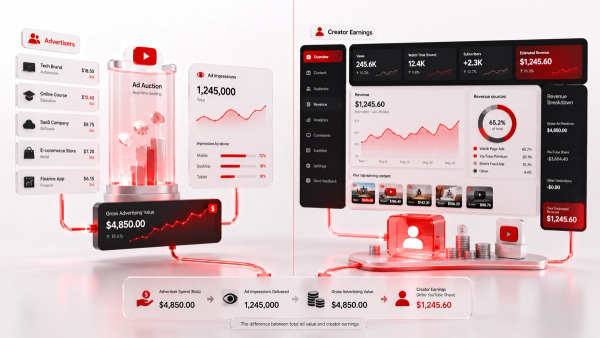
There is no fixed rate. YouTube does not pay per view, and it never has. It pays a share of the ad revenue generated on and around your videos, which depends on what advertisers are willing to pay, how many of your viewers actually see an ad, and how long they keep watching. The metric that captures all of this in a single number is RPM — revenue per mille, or revenue per 1,000 views. When someone says "YouTube pays $X per 1,000 views," they are almost always quoting an RPM. A realistic way to think about 2026 long-form RPM looks like this:
- Low-RPM niches and audiences: $0.50 to $2 per 1,000 views
- Average across all creators: roughly $2 to $6
- High-value niches (finance, tech, business): $8 to $20 or more
- Audiences in the US, UK, Canada, and Australia: typically 3 to 10 times higher than developing markets
These are estimates, not promises. Your actual figure depends on your niche, your audience's location, your video length, and the time of year. But they give you a realistic starting point instead of the "1,000 views = $2.50" figure that circulates around the internet, which is accurate for almost nobody in particular.
Why Earnings Differ Between Channels
Two channels with identical view counts can earn ten times differently, and it's worth understanding why before you start chasing views. The biggest drivers are:
- Niche — advertisers pay more to reach audiences that buy expensive products. Finance and software command premium rates; gaming and entertainment do not.
- Audience location — viewers in high-CPM countries produce far more revenue per view than viewers in low-CPM markets.
- Watch time — the longer people stay in your video, the more ad opportunities appear.
- Video length — videos over 8 minutes can carry mid-roll ads, multiplying paid impressions per viewer.
- Ad load — how many ads you enable and where you place them.
- Season — advertiser budgets spike in the holiday quarter and shrink early in the year.
If you remember nothing else, remember this: RPM is a multiplier, and it moves more than views do for most creators. A channel that doubles its RPM earns twice as much without publishing a single extra view.
How YouTube Calculates Creator Revenue
The formula is simple to write and trickier to feed correctly: Estimated earnings = monetized views ÷ 1,000 × RPM If a video gets 100,000 monetized views at a $5 RPM, the math is 100,000 ÷ 1,000 × 5, which equals $500. Double the RPM to $10 and the same video earns $1,000. Views and RPM are the two levers, and you control parts of both. The tricky part is the word "monetized." Not every view shows an ad. YouTube serves ads on a percentage of views depending on ad inventory, video length, geography, and whether a viewer uses an ad blocker. RPM already accounts for all of this — that's exactly why it's the honest number. It's real revenue divided by real views, so everything you're not getting paid for is already baked out of the result.
RPM vs CPM
CPM means cost per mille — what an advertiser pays YouTube for 1,000 ad impressions. RPM is what you actually keep per 1,000 views. Between the two sit YouTube's cut and the fact that not every view carries an ad. A channel might report a $20 CPM and an $8 RPM. The gap isn't lost money; it's the platform share (YouTube keeps roughly 45% of long-form ad revenue in 2026) plus the views that never served an ad. When a creator says "my CPM is $20," they're describing what advertisers pay, not what they earn. When you're comparing earnings or setting expectations, always work with RPM. It's the number that actually reaches your AdSense balance.
Average YouTube Earnings Per 1,000 Views
Let's make this concrete with three example scenarios. These are illustrative calculations, not guarantees of what you'll earn. Low RPM example. A gaming channel with a mix of Indian and Brazilian viewers running at a $1 RPM. At this rate, 1,000 views earns $1. A video that hits 100,000 views earns $100. Growth is entirely possible here, but ad revenue alone won't fund a lifestyle quickly. Average RPM example. A tech-review channel with a US and UK audience at a $6 RPM. 1,000 views earns $6. A video that reaches 100,000 views earns $600. For a channel publishing two or three of those a month, ad revenue becomes a genuinely useful side income. High RPM example. A personal finance channel with a predominantly US audience at a $15 RPM. 1,000 views earns $15. A 100,000-view video earns $1,500. And because finance audiences are so valuable to advertisers, a single strong video can keep generating that kind of money for months. The pattern across all three: RPM is the multiplier, and it moves more than views for most creators. Nowhere is this clearer than when the same view count runs through different RPMs:
- $1: $1, $100, $1,000
- $4: $4, $400, $4,000
- $8: $8, $800, $8,000
- $15: $15, $1,500, $15,000
- $25: $25, $2,500, $25,000
Every row is simple arithmetic: views divided by 1,000, multiplied by RPM. The dramatic differences come entirely from the RPM input.
How Much YouTube Pays for 1,000 Views by Niche
The table below shows typical long-form RPM ranges by niche in 2026. These reflect advertiser demand, not content quality — advertisers pay more to reach audiences that can buy expensive products.
- Personal finance: $10–$25
- Business and entrepreneurship: $8–$20
- Software and tech: $6–$15
- Digital marketing: $6–$15
- Education: $5–$12
- Health and wellness: $4–$10
- Travel and lifestyle: $2–$6
- Entertainment: $1–$4
- Gaming: $1–$3
- Vlogging: $1–$4
A wildly entertaining gaming video can out-earn a mid-level finance video on raw views. But per 1,000 views, the finance channel wins every single time, because each of its viewers is worth more to advertisers.
How Country Affects YouTube Earnings
Audience location is one of the largest single drivers of RPM. Advertisers bid differently in every market, and those bids flow straight into what you earn.
- US, Canada, UK, Australia: highest-CPM markets, and therefore the highest RPMs
- Western Europe (Germany, France, Nordics): strong rates, usually below the US
- India, Brazil, Southeast Asia: low CPMs, though massive volume can partially compensate
A 100,000-view video with 90% US traffic at a $10 RPM earns $1,000. The same video with 90% Indian traffic at a $1.50 RPM earns $150. Same views, same content, radically different outcome. This is why creators building for income think hard about audience geography, and why "how much does YouTube pay per 1,000 views" has so many answers — everyone asking is speaking from a different market.
How Video Length Affects Revenue
Longer videos usually earn more per view for two reasons: more ad slots and more accumulated watch time. Videos over 8 minutes can carry mid-roll ads, which multiplies the number of ad impressions each viewer generates. A 12-minute video that holds 50% retention may serve two or three ad breaks; a 3-minute video serves one pre-roll at best. But longer isn't automatically better. A padded 20-minute video that viewers abandon after two minutes earns less than a sharp 10-minute video people finish. Watch time is the true currency; length is just one way to earn more of it. The creators who win tend to earn watch time honestly rather than stretching content thin.
How Many Ads Can Appear on a Video?
YouTube's policies allow multiple ad breaks on videos that are 8 minutes and longer, and creators can choose between automatic and manual ad placement. More breaks usually mean more revenue, but they carry a trade-off: interrupt too aggressively and retention drops, which lowers earnings anyway. The channels that perform best monetize aggressively enough to capture revenue but gently enough to keep viewers watching — typically spacing mid-rolls at natural chapter breaks rather than scattering them randomly.
YouTube Shorts vs Long-Form Earnings
Shorts run on a completely different model. Ad revenue from the Shorts feed is pooled across all monetized creators, music licensing costs are deducted, and the remainder is split based on each creator's share of eligible views. In 2026 that works out to roughly $0.03 to $0.10 per 1,000 Shorts views for most creators — sometimes a little higher with a strong US audience. A million Shorts views might earn $30 to $100, where a million long-form views in a decent niche could earn $1,000 to $10,000. That doesn't make Shorts worthless. They're a discovery engine: bursts of reach that can pull viewers into your longer, higher-RPM videos, your subscriber base, and your products. But if your goal is direct ad revenue per view, long-form is the money format. If you're weighing the two, the Shorts vs long-form comparison has more detail on how each one monetizes.
Calculate Your YouTube Earnings
You can run this math by hand, but it becomes tedious when you're testing multiple scenarios. Instead of doing the arithmetic yourself, the Thumbix YouTube Money Calculator lets you enter views, RPM, and CPM to see estimated earnings per video, per 1,000 views, and across a full year of uploads. Pair it with the RPM Calculator and the CPM Calculator to convert between the two metrics, or use the Revenue Goal Calculator to work backward from a target income to the views you'd need to reach it. The results are estimates, but they're built on the same formula YouTube uses, so they're honest rather than inflated.
How to Increase Your Revenue Per 1,000 Views
- Know your real RPM — read it from YouTube Studio under Analytics → Revenue before changing anything.
- Optimize for high-value countries — topics and language that attract US, UK, Canadian, and Australian viewers.
- Target advertiser-friendly niches — finance, software, and business topics carry premium CPMs.
- Make longer, watchable videos — 8+ minutes with natural mid-roll placement.
- Focus on retention — a video people finish earns more per view than one they abandon.
- Be selective with ads — aggressive mid-rolls hurt retention; balance works better.
- Build topic authority — advertisers and the algorithm both reward channels that clearly own a niche.
- Check seasonality — plan big content pushes for the high-advertising fourth quarter.
Final Takeaway
YouTube doesn't pay a flat rate per 1,000 views — it never has. What you earn is your RPM times your views, and RPM is shaped by niche, country, video length, retention, and season. The creators who stop guessing and start measuring always come out ahead. Pull your real number from Studio, model a few scenarios with a calculator, and build content around the two levers you can actually move: more monetized views and a higher RPM. Want to run your own numbers? Try the free Thumbix YouTube Money Calculator to estimate what your views are actually worth — per video, per 1,000 views, and per year.
Frequently Asked Questions
How much does YouTube pay per 1,000 views in 2026?
Most long-form creators earn roughly $1 to $6 per 1,000 monetized views. Finance and tech channels often earn $8 to $20 or more, and Shorts typically pay $0.03 to $0.10 per 1,000 views.
Is there a fixed rate YouTube pays per 1,000 views?
No. YouTube pays a share of ad revenue, expressed as RPM. The amount varies by niche, audience country, video length, watch time, and season.
What is the difference between CPM and RPM?
CPM is what advertisers pay per 1,000 ad impressions. RPM is what you actually keep per 1,000 views after YouTube's revenue share and deductions.
Do YouTube Shorts pay the same as long-form videos?
No. Shorts monetize through a pooled revenue model and typically pay far less per view — often $0.03 to $0.10 per 1,000 views.
How do I find my actual RPM?
Open YouTube Studio, go to Analytics → Revenue, and read the RPM figure for the period you want. That's the truest 'what you keep' number available.
Why does my RPM change from month to month?
RPM shifts with advertiser demand, seasonality, the countries your viewers come from, and how much of each video your audience watches.
How can I increase my earnings per 1,000 views?
Attract audiences from high-CPM countries, target advertiser-friendly niches, publish longer videos that people finish, and place mid-roll ads at natural breaks.
How many views do I need to make money?
That depends entirely on your RPM. At a $5 RPM you need 20,000 monetized views for $100; at a $1 RPM you need 100,000. Our YouTube Money Calculator can work out your personal number.