Table of Contents
- Introduction
- How to Evaluate Any Faceless Idea
- High-RPM Ideas (Finance, Business, Tech)
- Mid-RPM Ideas (Education, History, True Crime)
- Volume Ideas (Motivation, Lifestyle, Trivia)
- The Idea Selection Scorecard
- Why Micro-Niches Beat Generic Ideas
- How to Model an Idea With the Calculators
- Frequently Asked Questions
- Final Takeaway
Not every faceless channel idea earns the same. Here are 12 concrete ideas grouped by RPM tier, each with content format, difficulty, and a realistic income range, plus how to model the numbers before you commit.
There is no shortage of faceless channel ideas on the internet, and almost no shortage of ways to waste a year on one that cannot pay. The ideas that actually make money share a pattern: they sit in a niche with real advertiser value, they fit a format you can produce without a face, and they have enough depth for a hundred videos. This article lays out twelve concrete ideas grouped by RPM tier, with the format, difficulty, and realistic income range for each, so you can compare them like a business rather than a lottery. Along the way you will get an evaluation scorecard, a note on why micro-niches beat generic ideas, and the free Thumbix calculators that turn any idea into a monthly income estimate before you spend a single week producing.
Introduction
Every faceless idea can be scored on four dimensions: RPM, production difficulty, volume required, and non-ad income potential. The ideas below are grouped by RPM tier, because that is the number that decides how many views you need for a given income. A $12-RPM idea needs one-sixth the traffic of a $2-RPM idea to earn the same money, and that single fact should drive most of your decision. All income figures here are estimates. They assume a channel that reaches monetization and publishes consistently, and they describe the range you might reasonably see in a solid year two, not a guarantee and not a month one. The difficulty rating is about production skill, not about how hard it is to compete; the micro-niche strategy is how you reduce competition on any idea.
How to Evaluate Any Faceless Idea
Before you pick from the list, know the questions to ask of any idea. First, what RPM does the niche typically earn? Use the known ranges in this article or your own research, because RPM is the multiplier on everything. Second, what format does it require, and can you produce that format every week? A documentary channel you cannot sustain is a bad idea even at a high RPM. Third, how many views will you need for your income target? The formula is income divided by RPM times 1,000, which gives the monthly monetized views required. Fourth, what non-ad income exists? Sponsorships, affiliates, and products can double or triple an idea's ceiling. Score each idea honestly on these four questions before you produce anything. The idea with the best score on paper is not always the one you will love, but it is always the one you should run the numbers on first. A note on honesty in this evaluation: the income ranges in this article describe what consistent, monetized channels in each tier typically see, not what a brand-new channel should expect in month one. The gap between an idea's ceiling and its first-year reality is filled by effort, retention, and time. That is why the scorecard and the calculators matter so much, because they separate the idea's inherent economics from the hype of a single viral example. Every profitable faceless channel started as a mediocre idea executed consistently, and every abandoned channel started as a great idea executed twice.
High-RPM Ideas (Finance, Business, Tech)
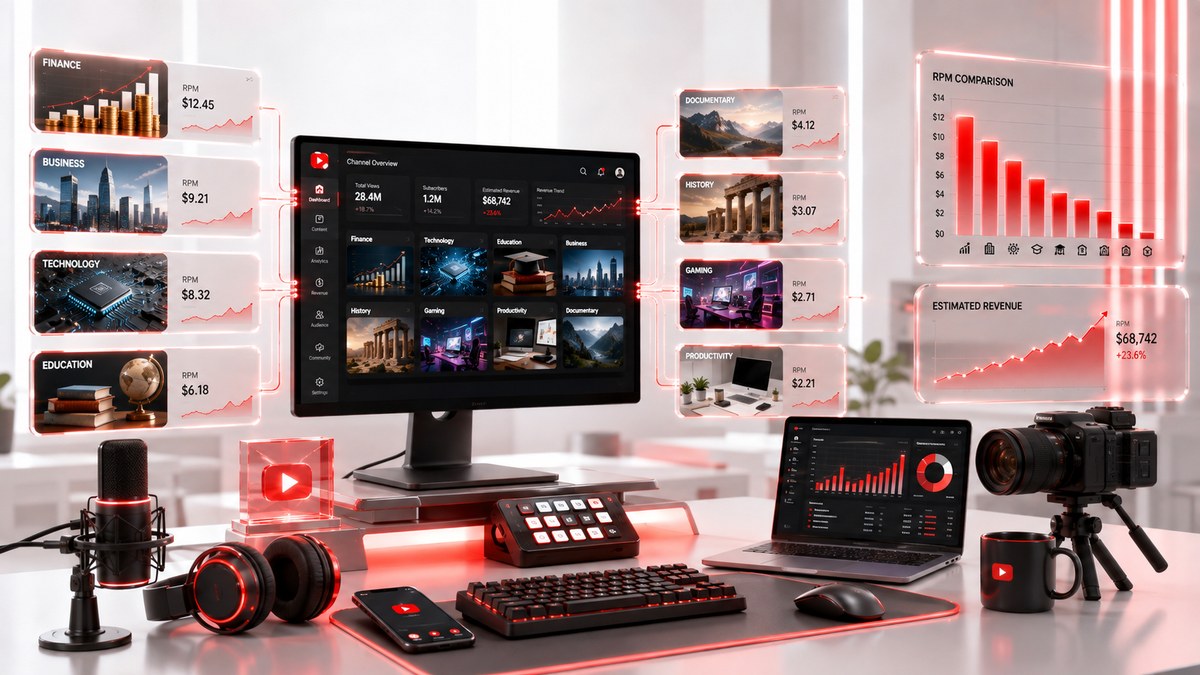
These ideas typically earn $5 to $20 RPM and need the least traffic for a given income. They are the hardest to research and the most durable. Personal finance explainers ($8-$20+ RPM, medium difficulty). Budgeting frameworks, debt strategies, investing basics, and money myths explained with charts and voiceover. The trust bar is high, so accuracy is non-negotiable, and the sponsorship market ($40-$80 CPM) is the strongest in faceless content. Business case studies ($8-$15 RPM, medium-hard difficulty). Rise-and-fall stories and industry breakdowns in documentary format. The moat is production quality, and the content stays evergreen for years. AI tool reviews and news ($5-$15 RPM, medium difficulty). Screen-recorded demos and comparisons of AI tools. Strong affiliate commissions (20% to 65% recurring in SaaS) make this the best non-ad income play on the list. Tech tutorials ($5-$15 RPM, medium difficulty). Software walkthroughs and workflow guides built on screen recordings. Freshness is the cost; tool updates date videos within months. These four ideas share the same economics: roughly 50,000 to 200,000 monthly monetized views can produce $1,000 a month from ads alone, before affiliates and sponsorships. They also share the same risk: because the money is good, the research bar is high, and viewers in finance, business, and tech are the least forgiving of sloppy facts. If you come to these niches, come prepared to verify every number you say on camera. That verification is not a chore; it is the moat that keeps the lazy AI clone channels from competing with you.
Mid-RPM Ideas (Education, History, True Crime)
These ideas earn $3 to $10 RPM and offer the best balance of producibility and pay. They need more traffic than the high tier but far less than the volume tier. Education and science explainers ($5-$10 RPM, hard difficulty). Animated explainers and how-it-works videos that become evergreen assets. Slow to produce, but a library of twenty strong explainers can carry a channel for years. History documentaries ($3-$8 RPM, medium difficulty). Voiceover plus stock across one era, region, or theme. The micro-niche matters more here than anywhere; one century beats all of history. True crime ($3-$8 RPM, medium difficulty). Narrative storytelling with the strongest retention of the mid tier, which lifts RPM toward the top of the range. Accuracy and sensitivity are mandatory. Book summaries and insights ($3-$8 RPM, easy-medium difficulty). Condensing one non-fiction book per video with voiceover and simple graphics. Easy to produce, evergreen, and a natural fit for affiliate book links. These ideas typically need 100,000 to 333,000 monthly monetized views for $1,000 from ads, and they reward a steady long-form cadence over virality.
Volume Ideas (Motivation, Lifestyle, Trivia)
These ideas earn $2 to $5 RPM and need the most traffic, but they are the easiest to produce and the most Shorts-friendly. Treat them as volume plays with a business plan beyond ads. Motivation and mindset ($2-$5 RPM, easy difficulty). Text-on-screen quotes and voiceover motivation clips. Perfect for Shorts loops; monetize through memberships, merchandise, and affiliate offers rather than ads. Luxury and lifestyle ($2-$5 RPM, easy difficulty). Watch collections, travel inspiration, and aspirational content built on stock and b-roll. Low RPM but huge volume and strong brand-affiliate potential. Productivity and habits ($3-$6 RPM, easy-medium difficulty). Frameworks and routines presented with clean graphics. Relatable content that sponsors and affiliate partners in apps and tools like to support. Quiz, trivia, and facts ($2-$5 RPM, easy difficulty). Rapid-fire facts and question formats that perform strongly as Shorts. Volume is the entire game, so batch production is essential. News and commentary ($3-$6 RPM, medium difficulty). Voiceover commentary on current events in a chosen lane, from markets to tech news. This idea trades evergreen value for freshness, so it demands a real publishing engine, but it builds a daily-viewer habit that sponsors like. If you pick it, anchor it to a theme so your commentary has a point of view, because generic news aggregation pays like the commodity it is. At $2 to $5 RPM, $1,000 a month needs 200,000 to 500,000 monetized views, which these formats can reach through Shorts traffic but only with constant output. The income range below assumes you build the non-ad streams, not just ads.
The Idea Selection Scorecard
Here is a repeatable scorecard for comparing any two ideas. Rate each from 1 to 5, then compare totals.
- RPM: How much per 1,000 monetized views?, 5
- Producibility: Can I make this every week for a year?, 4
- Non-ad income: Do sponsorships or affiliates exist?, 4
- Evergreen: Will the library still earn in 3 years?, 3
- Passion: Can I research it for 1,000 hours?, 3
An idea scores high when the RPM is strong, you can produce it indefinitely, and it has affiliate or sponsorship income on top of ads. The passion score is not a soft bonus; it is the best predictor of whether you will still be publishing in month six, which is the moment most channels actually start to grow.
Why Micro-Niches Beat Generic Ideas
Every idea on this list gets stronger when you narrow it. Personal finance becomes budget strategies for small-business owners. History becomes one war, one region, or one industry's history. AI reviews become AI tools for one workflow. Tech tutorials become one software category. The reasons are mechanical. YouTube needs to know who to show a video to, and a narrow channel gives it a clear audience. Advertisers pay more for precise audiences. Sponsors prefer channels whose viewers match their product exactly. And you build authority faster, because a viewer who watches three of your videos sees an expert, not a generalist. The views per video will be smaller at first. The RPM, retention, and conversion will be better, and those beat raw views on every faceless business model. Concretely, a micro-niche is not a smaller version of a big niche; it is a different product. A general finance channel promises to cover money; a micro-niche channel about emergency-fund strategies promises one specific problem, which means every search it ranks for is a viewer with intent. That intent is exactly what raises retention, and retention is what raises both RPM and algorithm distribution. If an idea in the list feels too broad, your job is to find the smallest audience that still has a clear problem, because that audience is the one you can actually own.
How to Model an Idea With the Calculators
Pick two or three ideas from the list and run the same numbers on each. For every idea, enter a realistic year-two monthly view count and the niche's typical RPM into the YouTube Money Calculator to get a monthly and annual ad income estimate. Then add a sponsorship and affiliate assumption with the Revenue Goal Calculator to see what the idea needs to hit your income target, and use the CPM Calculator to sanity-check whether the niche's advertiser rates actually support the RPM you assumed. A concrete example: a personal finance micro-niche at 40,000 monthly views and a $12 RPM produces about $480 a month from ads, and one $1,500 sponsorship a month doubles it. A motivation channel at 400,000 views and a $3 RPM produces about $1,200 a month from ads alone, but needs ten times the production volume to get there. Those two numbers should decide between the ideas, not the marketing glow of one of them. The whole exercise takes about fifteen minutes and it will save you a year of producing the wrong idea. One more thing to model before you commit: production cost. Every idea has a weekly time and money cost, and the calculator results only mean something when compared against what you are willing to invest. A high-RPM documentary idea that takes twenty hours a week and a $300 monthly stock budget is a different business than a mid-RPM screen-recording channel you can run in eight hours. Model the income, subtract the honest cost, and choose the idea with the best net result you can actually sustain.
Final Takeaway
The faceless ideas that make money in 2026 are not secret; they are finance, business, tech, education, history, and a few high-volume formats, and the difference between them is mostly RPM and producibility. Pick from the highest-RPM tier you can sustain, narrow the idea into a micro-niche, and check the numbers with a calculator before you produce anything. Run your shortlist through the free Thumbix YouTube Money Calculator and the Revenue Goal Calculator to see monthly and annual estimates for each idea, then commit to the one whose numbers and your stamina both support.
Frequently Asked Questions
What faceless channel ideas actually make money?
The highest earners are finance explainers, business case studies, AI tool reviews, and tech tutorials ($5-$20 RPM), followed by education, history, and true crime ($3-$10 RPM). All figures are estimates.
How do I choose between faceless ideas?
Score each on RPM, producibility, non-ad income, evergreen value, and passion. The idea that wins on those five factors beats the one that wins on hype.
What is the easiest faceless format?
Text-on-screen motivation and trivia clips are the easiest, but they pay the lowest RPM and need volume. Screen-recorded tutorials and voiceover stock content are the easiest formats that still earn well.
How much can each idea earn?
High-RPM ideas need about 50,000 to 200,000 monthly monetized views for $1,000; mid-RPM ideas need 100,000 to 333,000; volume ideas need 200,000 to 500,000, plus non-ad income.
Why do micro-niches beat generic ideas?
Narrow channels give YouTube a clear audience to target, command higher advertiser value, attract better sponsors, and build authority faster.
Which faceless idea has the best non-ad income?
AI tool reviews and tech tutorials have the strongest affiliate income, with SaaS programs paying 20% to 65% recurring. Finance has the strongest sponsorship market at $40-$80 CPM.
How many views do I need for $1,000 a month?
At a $12 RPM, about 83,000 monetized views. At a $5 RPM, about 200,000. At a $2 RPM, about 500,000. The YouTube Money Calculator works out your exact number.
Should I pick the highest-RPM idea I can find?
Only if you can sustain it. A niche you abandon in month two earns nothing, so choose the highest-RPM idea from the ones you can produce every week for a year.