Table of Contents
- Introduction
- What YouTube Automation Actually Is
- What YouTube Automation Is Not
- How an Automated Channel Is Structured
- Where AI Fits (And Where It Doesn't)
- Realistic Income Stages for Automated Channels
- The 2025 Demonetization Wave and the New Quality Bar
- Automation Costs and the Lean Budget
- Modeling Per-Video Economics Before You Hire
- How to Avoid the Common Automation Failures
- Frequently Asked Questions
- Final Takeaway
YouTube automation in 2026 means outsourced, AI-assisted production run by a manager, not a machine that prints money. Here is what the model really is, what it makes, and where the demonetization wave reset the bar.
Few phrases in the creator economy are as misunderstood as YouTube automation. On social media it means a machine that produces videos while you sleep and money prints in the background. In reality, in 2026, YouTube automation means a production model: a manager who outsources or AI-assists the research, scripting, voiceover, editing, and packaging of a channel, so the founder does not appear on camera and does not do the production work personally. It is a legitimate business model with real earnings, and it is also the most oversold idea on YouTube. Both things are true, and understanding the gap between them is the whole point of this article. We will cover what the model actually looks like, what it realistically earns by stage, where the 2025 demonetization wave reset the quality bar, and how to model a single video's economics before you spend a dollar on a freelancer or an AI tool.
Introduction
Automation channels sit at the intersection of two of YouTube's biggest trends: faceless content and AI-assisted production. The typical setup is a founder who picks a niche, owns the strategy and the brand, and contracts out the production steps to freelancers or AI tools. The founder rarely appears on camera, often works from a spreadsheet rather than an edit suite, and scales by adding more content volume or more channels. The appeal is obvious: leverage. Instead of one person's ten hours a week, a pipeline can produce several finished videos a week. The reality is more sobering. The founder becomes a manager with quality-control duties, income arrives in stages rather than overnight, and the platforms quality bar keeps rising. The channels that thrive in 2026 treat automation as a discipline, not as a shortcut, which is the difference between a real asset and a demonetized pile of AI slop.
What YouTube Automation Actually Is
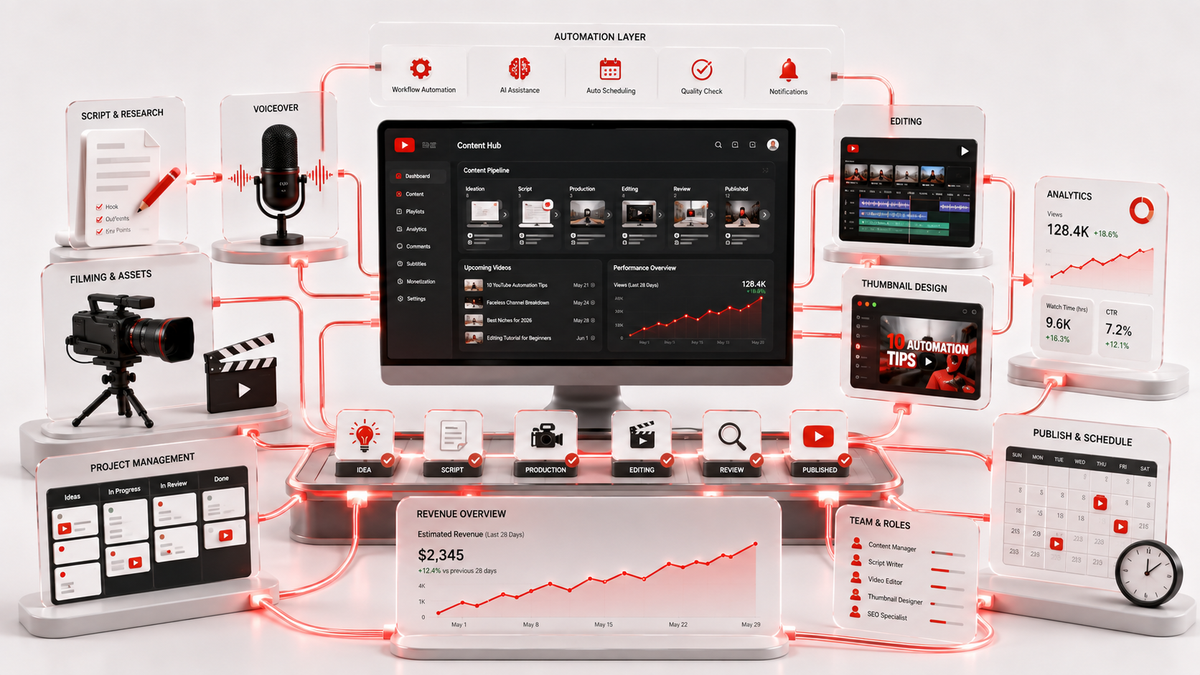
At its core, YouTube automation is the industrialization of the content pipeline. A typical automated channel separates production into distinct steps, each of which can be outsourced or assisted:
- Research: finding topics with proven demand and advertiser value.
- Scripting: writing the video in a voice viewers trust.
- Voiceover: recording narration, by a human voice actor or a high-quality AI voice.
- Visuals: sourcing stock footage, screen recordings, or motion graphics.
- Editing: assembling, pacing, and adding sound design.
- Packaging: title, thumbnail, description, and tags.
- Publishing: scheduling uploads and monitoring analytics.
In a fully automated setup, the founder owns only strategy and quality control, and every production step is handled by someone else. In a hybrid setup, the founder produces some steps personally and outsources others. Both are automation; the difference is how much of your own time remains in the loop. The honest name for this is small-business management. The founder hires, briefs, reviews, and fires. The leverage is real, but the work is real too, especially in the first year.
What YouTube Automation Is Not
This matters more than the definition above, so let us be blunt about what automation is not. It is not fully passive income. Expect 10 to 15 hours per week of management work early on, dropping to 2 to 5 hours per week only after roughly 12 months, once your pipeline is proven and your freelancers are trained. Anyone selling month-one passivity is selling a fantasy. It is not guaranteed income. Most automated channels earn $0 to $300 in months 1 to 3, $300 to $1,500 in months 4 to 6, and only reach $2,000-plus months around month 9 to 12 when things go well. A large fraction never reach the high end. It is not free. Automation replaces your time with money. Freelance scriptwriting, voiceover, and editing cost real budgets, and quality tools add $30 to $100 per month before you count labor. It is not a license to publish low-quality content. The single biggest automation failure of the last two years was the assumption that AI could replace quality control. It cannot, and YouTube demonstrated exactly what happens to channels that try.
How an Automated Channel Is Structured
A well-run automated channel looks more like a small agency than a content farm. The founder is the creative director, setting the niche, the audience, the format, and the editorial standard. Below the founder, production is split across contractors or tools:
- One researcher or a research tool to generate topic candidates.
- One scriptwriter who can hold a consistent voice.
- One voice talent or AI voice pipeline for narration.
- One editor for assembly and pacing.
- One thumbnail designer, either freelance or AI-assisted.
The founder reviews the finished video the same way an editor reviews a publication: is the claim accurate, is the story clear, is the packaging honest? That review step is the difference between a professional channel and a spam channel, and it cannot be delegated away. Most successful automated founders run one channel to a working standard first, then clone the pipeline to a second niche rather than starting multiple half-managed channels at once. Volume does not fix quality; quality is the prerequisite for volume.
Where AI Fits (And Where It Doesn't)
AI is a genuine accelerator in 2026, and the honest automation playbook uses it selectively. AI is strong at research summaries, first-draft scripting, transcription, caption generation, and image ideation. It is weak, or dangerous, at final editorial judgment, factual verification, and anything involving trust with an audience. A realistic AI-assisted workflow looks like this: AI suggests topics from your analytics and competitor research; a human scriptwriter (or a heavily edited AI draft) produces the script; an AI or human voice delivers it; stock and graphics are assembled in a template; and a human reviews the entire video for accuracy, pacing, and monetization policy compliance before publishing. The line that matters is control. The moment an AI produces a video with no human review step, the channel is no longer automated; it is unmanaged, and unmanaged channels are exactly the ones that get demonetized for low-effort or reused content. YouTube's monetization policies in 2026 require original, quality content, and AI does not change that requirement.
Realistic Income Stages for Automated Channels
Every figure here is an estimate, and income is never guaranteed. For planning, automated channels tend to move through these stages:
- Months 1-3: $0 to $300. The pipeline is being built and the channel is usually still below monetization.
- Months 4-6: $300 to $1,500. Early ad revenue arrives, and a first affiliate placement or small sponsorship can appear in advertiser-friendly niches.
- Months 9-12: $2,000-plus months for channels that found traction, combining ads, affiliates, and sponsorships. Many channels stay lower.
Behind the stages is the same arithmetic as any channel. At a $5 RPM, $1,000 a month needs about 200,000 monetized views. At a $10 RPM, about 100,000. Automation does not change the views-to-income math; it changes how many videos you can produce toward that target, which is its real and only superpower. A real-world reference point: a first-year faceless channel with roughly 777,000 views and 38 videos earned about $700 in ad revenue. An automated operation is not automatically better than that; it simply aims to produce more consistent volume toward it.
The 2025 Demonetization Wave and the New Quality Bar
In 2025 YouTube applied a wave of demonetization and removal to lazy, copy-paste AI clone channels, and it reshaped the automation landscape. Channels that stitched reused AI voiceover over generic footage, with no original research or human editing, were among the heaviest losers. The message was unambiguous: monetization is not a reward for volume; it is a reward for original, quality content that follows the policies. For automation founders, 2026 is the quality era. The bar now includes original scripts, factual accuracy, coherent editing, honest packaging, and a human review step in the pipeline. The good news is that this wave culled exactly the competitors a serious operator did not want to compete with. The quality bar is now a moat, and crossing it is the entire job. If you are starting automation in 2026, read the monetization policies and the reused content rules before you hire anyone. Compliance is a pipeline feature, not an afterthought.
Automation Costs and the Lean Budget
Automation replaces your time with money, so the budget question is central. A lean automated channel can run on roughly $30 to $100 per month in tools, before freelancers. A lean 90-day trial including modest freelance help lands near $300 total. A quality setup with a real editor, a professional voice, and paid tools runs about $1,500. The mistake beginners make is optimizing the cheapest step. Save money on template visuals, not on editing quality or factual research, because those are the two places demonetization and dead audiences come from. Treat the first 90 days as a paid experiment: a fixed budget, three to six videos, and a decision rule for whether the niche and pipeline are viable. If the retention numbers are weak by week eight, change the format or the niche before scaling spend.
Modeling Per-Video Economics Before You Hire
The most professional question you can ask before automating anything is: is one video worth its production cost? The answer is arithmetic, and it decides everything downstream. Estimate the realistic monetized views for a video in your niche, multiply by your expected RPM, divide by 1,000, and compare that per-video income to the all-in cost of producing the video, including freelancers and tools. The Revenue Per Video Calculator does exactly this, and it is the first tool to open before you hire anyone. Then model the channel. The YouTube Money Calculator turns your expected views and RPM into monthly and annual income, which you compare against your projected monthly spend on freelancers and tools. And because automation only pays off through volume, the Upload Frequency Calculator shows the publishing cadence your budget can sustain and what that cadence implies for views and income over a quarter. This sequence, cost per video, channel income, and sustainable cadence, is the entire financial case for automation, and it takes about ten minutes to run.
How to Avoid the Common Automation Failures
The failures in automation are remarkably consistent, and each has a fix.
- Publishing before quality: ship three videos of a standard you would show a client, and hold every video to it.
- Skipping the human review: every video needs a factual and policy review before upload, no exceptions.
- Copying a niche without checking RPM: automation multiplies whatever RPM your niche earns, including a low one.
- Scaling spend before the model works: prove retention on a small budget first.
- Treating ads as the only income: the channels that reach $2,000 months combine ads with affiliates and sponsorships.
- Neglecting the packaging: a great video with a weak title and thumbnail earns a fraction of its potential, so invest in the hooks.
None of these failures is exotic. They are the ordinary mistakes of managing a production pipeline, and they are all preventable with process.
Final Takeaway
YouTube automation is a real business model built on outsourcing and AI assistance, and it is also one of the most oversold ideas in the creator economy. It means managing a production pipeline, not collecting passive cash, and its income arrives in stages: near zero in the first quarter, building through the second, and reaching $2,000-plus months only after roughly a year when things go well. The 2025 demonetization wave reset the bar, and in 2026 originality and human review are non-negotiable pipeline steps. Before you hire anyone, model the economics of a single video: views, RPM, cost, and what cadence the numbers support. Run that through the free Thumbix Revenue Per Video Calculator, the YouTube Money Calculator, and the Upload Frequency Calculator, and let arithmetic, not hype, decide whether automation is your model.
Frequently Asked Questions
What is YouTube automation?
It is a production model where the founder outsources or AI-assists research, scripting, voiceover, editing, and packaging, while owning the strategy and quality control. It is business management, not a passive machine.
Is YouTube automation passive income?
Rarely at the start. Expect 10 to 15 hours per week of management work early on, dropping to 2 to 5 hours per week after about 12 months once the pipeline is proven.
Does YouTube allow automated channels?
Yes, as long as the content is original, quality, and follows monetization policies. The 2025 demonetization wave targeted lazy copy-paste AI clone channels, not legitimate production models.
How much do automation channels make?
Most earn $0 to $300 in months 1 to 3, $300 to $1,500 in months 4 to 6, and $2,000-plus months from month 9 onward when things go well. All figures are estimates.
Is YouTube automation dead in 2026?
No, but the low-effort version is. Automation now requires a real quality bar, human review, and a per-video economic model.
What does an automated channel cost to run?
A lean 90-day trial runs about $300, and a quality setup about $1,500, plus $30 to $100 per month in tools.
How do I know if a video is worth producing?
Estimate monetized views times RPM divided by 1,000 and compare to production cost. The Revenue Per Video Calculator does this automatically.
How many videos should an automated channel publish?
Whatever cadence the per-video economics support. The Upload Frequency Calculator shows the sustainable publishing schedule for your budget and niche.